Rape Gang Inquiry Has Now Begun in UK February 2026
RapeGangInquiryHasNowBegunInUKFebruary202
US President Donald Trump announces to the world that the US and Israel have launched joint strikes and Major Combat Operations on Iran
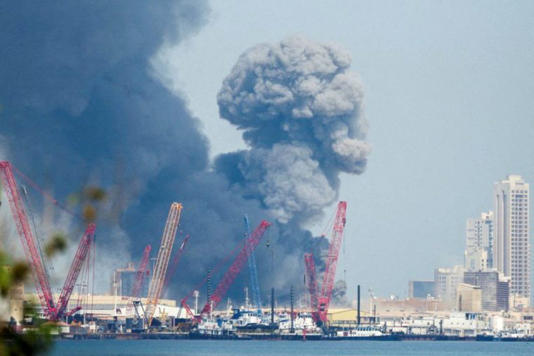
Smoke rises in the sky after blasts were heard in Bahrain’s capital, where a US Navy fleet is headquartered

The Iranians are also using kamikaze drones to strike residential buildings and airports in the Middle East

Terror fears skyrocket after Iran strikes as FBI issues chilling alert
Terror fears skyrocket after Iran strikes as FBI issues chilling alert'
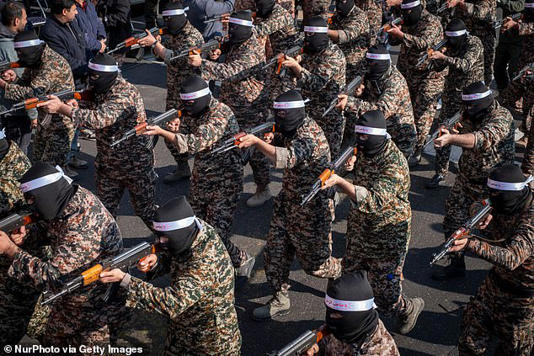
Iran uses a network of proxy militant groups around the globe to carry out violent attacks against Western countries
The FBI has issued a chilling warning to Americans as fears grow Iran will strike the US through its terrorist proxies. FBI counterterrorism and counterintelligence teams are on elevated alert across the country, according to an agency official. Terrorism fears are surging in the wake of Donald Trump's military strikes on Iran, as reports circulate that the Islamic regime's supreme leader was killed.
Iran uses a network of proxy militant groups around the globe to carry out violent attacks against Western countries.
The FBI did not say how long the terror alert will remain in effect. Meanwhile, Kristi Noem said Homeland Security is 'in direct coordination with our federal intelligence and law enforcement partners as we continue to closely monitor and thwart any potential threats to the homeland.'
Under orders from the president, the US military launched Tomahawk missiles on Iran in a joint operation with Israel, deploying Air Force and Navy jets. Iran responded to the aggression by launching 'revenge strikes' on US military bases across the Middle East.
Tehran has struck the Fifth Fleet service center in Manama, Bahrain, and claims to have hit bases across the region including in Qatar, the United Arab Emirates and Kuwait.
The Iranians are also using kamikaze drones to strike residential buildings and airports in the Middle East. Footage emerged on Saturday morning showing an Iranian drone crashing into a high-rise apartment building in Bahrain.
The president warned that US troops could lose their lives, adding that 'we may have casualties.' Casualties from Iran's retaliatory strikes on US bases remain unclear.
Trump was reportedly warned by his top military advisers that Iran could respond to strikes with terror attacks with proxies on US soil. The president grew frustrated during the planning process to strike Tehran when his generals could not assure him that the risk of U.S. casualties would remain low.
Trump is already facing fierce political backlash for pulling the US into a new war in the Middle East.
Conservative podcasting titan Tucker Carlson branded Trump's attack 'absolutely disgusting and evil' as the president's MAGA base fractured. Carlson's break with Trump signals the decision to go to war with Iran could carry legacy-defining consequences for the president.
Trump won the 2024 presidential election with a campaign advocating against regime change wars in the Middle East. Trump, moreover, slammed 'so-called nation builders' during an investment conference in Saudi Arabia last May, adding they 'wrecked far more nations than they built.'
'And the interventionalists were intervening in complex societies that they did not even understand,' Trump claimed at the time. Now regime-change and nation building has become the central focus of the Trump administration's foreign policy. The number of US and Iranian casualties following Saturday's military attacks in the Middle East remains unknown at the moment.

FBI counterterrorism and counterintelligence teams are on elevated alert across the country following Trump's strikes on Iran
Rape Gang Inquiry Has Now Begun in UK February 2026
UK Rape Gang Inquiry Has Begun in the UK in February 2006
At least 85 people have been killed in an airstrike on an elementary school in southern Iran, according to the judiciary in Tehran.
The majority of the dead are schoolgirls aged between seven and 12, according to the regime-controlled news outlets Tasnim and Fars.
Missiles struck the Shajareh Tayyebeh school in the the city of Minab, in Hormozgan province, on Saturday morning as the US and Israel launched strikes on Iran.
Sources inside Iran told the Daily Mail that reports from the regime should be viewed with skepticism as a propaganda offensive is being waged under the fog of war.
A teacher at the school told the London-based outlet Middle East Eye that she saw bodies on classroom benches.
She had left the school to take care of something when she heard the blast. When she arrived back she saw carnage.
'I felt like I had gone mute. I couldn't speak,' she said. 'You could hear the sound of children crying and screaming.'
There were 170 girls at the school at the time of the attack as Saturday is the first day of the working week in Iran.
Footage shared on Telegram by accounts linked to the Islamic Revolutionary Guards Corps showed citizens digging through the rubble and smoke rising from the school building.
Iran's foreign minister Abbas Araghchi, who has been leading negotiations with Donald Trump's envoys Steve Witkoff and Jared Kushner, seized on the news.
'The destroyed building is a primary school for girls in the south of Iran. It was bombed in broad daylight, when packed with young pupils,' he posted on X.
'Dozens of innocent children have been murdered at this site alone.'
The US military, in a joint operation with Israel, launched tomahawk missiles on Iran with Air Force and Navy jets.
Tehran has struck the Fifth Fleet service center in Manama, Bahrain, and claims to have hit bases across the region including in Qatar, the United Arab Emirates and Kuwait.
Other US regional allies, including Iraq and Jordan, have also reported various missile activity from Iran.
The president warned that US troops could lose their lives in the operation, adding that 'we may have casualties.' The current casualties resulting from Iran's retaliatory strikes on US bases remains unclear.
Trump is already facing intense political backlash for hurling the US into a new war, with history rife with the disastrous consequences of Middle East conflicts.
Conservative podcasting titan Tucker Carlson branded Trump's attack 'absolutely disgusting and evil' as the president's MAGA base fractured.
Carlson's break with Trump signals that the decision to plunge the US into a major war with Iran could carry legacy-altering consequences for the president.
Former Congresswoman Marjorie Taylor Greene issued a statement denouncing the president, claiming he is betraying voters who supported him for ending foreign wars.
'Thousands and thousands of Americans from my generation have been killed and injured in never ending pointless foreign wars and we said no more. But we are freeing the Iranian people. Please,' the former GOP lawmaker wrote on Saturday.
'There are 93 million people in Iran, let them liberate themselves. But Iran is on the verge of having nuclear weapons. Yeah sure.'
Carlson spoke with U.S. Ambassador to Israel Mike Huckabee a week before the strikes on Iran, where the pair sparred over their differing views on Israel.
Huckabee made controversial comments during the interview that drew disapproval from US Gulf allies.
Carlson stated that, according to the Bible, the descendants of Abraham are entitled to land that today encompasses much of the Middle East.
In response to whether Israel had a right to take over the entire region, Huckabee said: 'It would be fine if they took it all'.
Huckabee then added that Israel was not seeking to expand its territory and has a right to maintain security on the land it legitimately holds.
His words provoked a heated international condemnation from Egypt, Jordan, Saudi Arabia, Kuwait, Oman, the Organization of Islamic Cooperation and the League of Arab States.
'How can one man create so much turmoil?' Ford unloads on Trump
'How can one man create so much turmoil?' Ford unloads on Trump
Canada offers full-throated support for Trump's attack on Iran
Canada threw its support behind the US after President Donald Trump ordered strikes on Iran in partnership with Israel. Prime Minister Mark Carney announced his backing for Trump's attack in a statement issued alongside Foreign Affairs Minister Anita Anand.
'Canada supports the United States acting to prevent Iran from obtaining a nuclear weapon and to prevent its regime from further threatening international peace and security,' the statement said.
Trump announced the attack in an eight–minute video posted on Truth Social around 2.30am ET, calling it a 'massive and ongoing operation' to prevent Iran from ever acquiring a nuclear weapon. The US President vowed to 'raze their missile industry to the ground' and 'annihilate their navy.' Carney and Anand said Canada's position remained 'clear' in the wake of the US–Israeli airstrikes.
'The Islamic Republic of Iran is the principal source of instability and terror throughout the Middle East, has one of the world's worst human rights records, and must never be allowed to obtain or develop nuclear weapons,' the statement read. Canada added it would 'take all possible measures to protect our nationals and Canadian Diplomatic Missions throughout the region.
World War 3 Possible Soon The Military Does Not Lie
Russia issues nuclear threat against NATO nation

Estonia could be in trouble
Tensions are rising on NATO’s eastern border after a Russian official threatened that Moscow would target an alliance member state with nuclear weapons if that member state stationed allied nuclear weapons in its country

"We do not threaten Estonia, as well as all other European countries, but if there are nuclear weapons aimed at us on the territory of Estonia, then our nuclear weapons will be aimed at the territory of Estonia, and Estonia must clearly understand this," Peskov explained, according to a quote cited by Newsweek.

“We are not against it”
“Bringing a nuclear weapon here to our territory—we are not against it,” the Estonian Defense Minister stated while speaking with the Estonian public broadcaster ETV on February 18th, according to a quote cited by United24.

“We are a country right on the border of an armed conflict, and we know what the attitude of the aggressive, imperial Russian Federation toward Poland is," Nawrocki added

However, despite the most recent nuclear sabre-rattling between Estonia and Russia, the Estonian Foreign Ministry noted that the role of nuclear weapons in the defense of the Baltic NATO nation was not a "current issue."

- Email: This email address is being protected from spambots. You need JavaScript enabled to view it.
- INLTV Uncensored News
-


Irish Crime Exposed www.usaweekly.com.au
Irish Crime Exposed | USA Weekly News
GoogleSearch INLTV.co.uk Y
AOLMail X Twitter euronews.com/live
W
New York Times April 2024 News Updates
Bahai.org AustralianDai
Does Iran have nuclear weapons and what missiles do they have?
 '
'As the world reels from what Trump has called ‘major combat operations’ by the US military in Iran, we are faced with more questions than answers.
What kind of nuclear weapons do enemies Iran and Israel possess — and how many? Could the conflict trigger a wider regional conflict – or even World War III?
Does Iran have nuclear weapons?
Both US intelligence and the UN’s nuclear watchdog, the International Atomic Energy Agency (IAEA), have said that Iran closed down its nuclear weapons development programme in 2003.
But according to the IAEA, Tehran has in recent years continued enriching uranium, including to near weapons-grade.
All three of the plants where that was happening were hit in the last US strikes on Iran last June.
However, while Trump gloated that the strikes had obliterated Tehran’s nuclear facilities, IEA director general Rafael Grossi warned Iran could resume enrichment on a more limited scale within months.
Iran has not allowed the UN to inspect either of the damaged facilities at Fordow, Natanz and Esfahan since last summer’s ’12-day war’
Airspace closed as Trump warns 'lay down your arms' in 'pre-emptive' strike on Iran
Airspace closed as Trump warns 'lay down your arms' in 'pre-emptive' strike on Iran
Donald Trump has warned the Iranian military to ‘lay down your arms or face certain death’ following airstrikes over the country
Airspace over Iran and Israel has been closed as Donald Trump warns the Iranian military to ‘lay down your arms or face certain death’ following airstrikes over the country.
The operation, which has been dubbed ‘Epic Fury,’ has seen both US and Israeli missiles hit the capital of Iran during the early hours of Saturday morning, Iranian time.
Mr Trump confirmed that he ordered the strikes in an attempt to end Supreme Leader Ali Khamenei’s reign, warning the Islamic Revolutionary Guard to ‘lay down your arms or face certain death.’
‘For 47 years, the Iranian regime has chanted ‘Death to America’ and waged an unending campaign of bloodshed,’ Mr Trump said. ‘It’s been mass terror, and we’re not going to take it any longer.’
Mr Trump added that there were ‘major combat operations’ underway in an attempt to destroy ‘menacing activities endangering the US and allies,’ and said Iran has attempted to rebuild its nuclear program and and was developing ling range missiles.
Addressing Iranian civilians, Mr Trump told them: ‘The hour of your freedom is at hand. When we are finished, take over your government, it will be yours to take.’
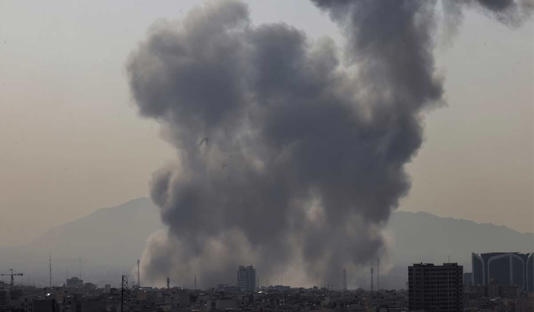
Strikes hit Iran in the early hours of Saturday morning
‘This will be, probably, your only chance for generations. For many years, you have asked for America’s help, but you never got it.’
Iran has since responded by launching rockets at Israel, with Israel responding with a ‘pre-emptive’ strike on Iran. Airspace over both countries has been closed to all flights.
Citizens in the US and Israel have been urged to leave Iran as soon as possible, while the US Embassy in Jerusalem ordered the evacuation of all non-emergency government personnel from Israel.
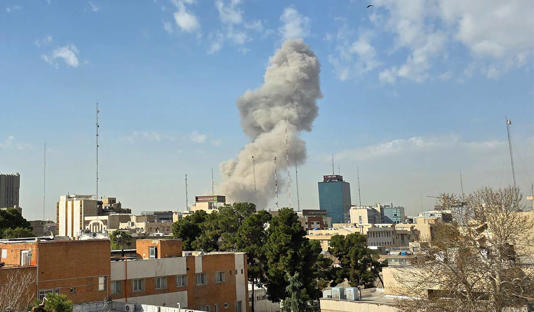
Israel also launched ‘pre-emptive’ strikes on Iran, with Iran firing missiles at Israel
The UK also evacuated embassy staff from Iran earlier this week, while China and Canada urged their citizens to flee as well.
The US are adamant that Iran accelerated efforts to build a nuclear bomb, and was working on ballistic missiles which could strike America.
Mr Trump previously said that he was going to give Iran 10 days to sign off on a new nuclear deal at a Board of Peace meeting on Thursday (February 26), so the overnight strike is being seen as somewhat surprising.
Trump’s Iran gamble has begun – and he looks increasingly desperate
Trump’s Iran gamble has begun – and he looks increasingly desperate

WASHINGTON, DC – Americans woke on Saturday to discover their country had gone to war for reasons that nobody has ever bothered to explain to them, and in search of an outcome the US government cannot specifically define.
Seven months after Donald Trump authorised a joint military operation with Israel that he claimed “totally obliterated” Iran’s nuclear programme via America’s bunker-busting bombs, the country is suddenly being asked to believe the Iranian regime had found itself within one week of obtaining sufficient material to serve as an “imminent threat” to the United States.
Neither Trump, his Secretary of State Marco Rubio, nor his Special Envoy Steve Witkoff has even attempted to explain that contradiction over the last fortnight, as the US assembled the most powerful military force in the region since George W. Bush attacked Iraq in 2003. Between them, the United States and Israel boast more than 500 combat aircraft in the region.
As chaos gripped Tehran Trump offered only generalities about his plans.
Announcing the start of “massive and ongoing” military operations against Iran, he directly proclaimed that his aim is the collapse of the regime. He called the Iranian government, “a vicious group of very hard, terrible people”. He offered no indication of what kind of administration he hopes will replace the one led by Supreme Leader Ayatollah Ali Khamenei. Trump made no mention of Reza Pahlavi, but instead ordered the Iranian people to take circumstances into their own hands.
He also urged members of Iran’s brutal Revolutionary Guard to lay down their arms and surrender, even though there is nobody to whom they can surrender to on the country’s streets.
Igniting a conflict his regional allies have long urged him not to wage, the American leader shows every sign of having decided to play a game of 52-card pickup in Iran, at a moment when his own approval ratings among US voters have hit record lows.
For weeks, he has been in need of a major distraction as Americans roundly reject his claims that the country’s economy is soaring, and after protestors in Minneapolis forced him into a humiliating partial retreat by thousands of federal agents enforcing his brutal mass deportation policies there, and gunning down two American citizens in the process.
Members of Congress have again been sidelined by the president. Very few of them appear even to have been awake when the military strikes began, though Senator Ruben Gallego, a Democrat from Arizona, said on social media that US troops should not have to “pay the ultimate price for regime change and a war that hasn’t been explained or justified to the American people”.
Read Next: Trump has run out of patience with Iran – this will be his biggest attack yet
By reportedly targeting both Khamanei and Iranian President Masoud Pezeshkian for possible assassination, Trump can also be accused of breaking even American law. The killing of foreign heads of government and other officials is prohibited by a statute that President Ronald Reagan enacted in December 1981.
Where things go from here, nobody in Washington knows. Trump, who came to power promising not to drag Americans into wars in far-off places about which they know little and understand even less, has waded in to Iran with no apparent plan for the future. His “America First” followers will be justified in wondering why they should back efforts to bring about the Iranian regime’s fall, at a time when their own government cannot explain how a wider regional conflict can now be avoided.
But in an effort to change the storyline threatening his fellow Republicans’ chances in November’s mid-term elections, Trump has decided to go for broke. He can only hope that the brute force of the US and Israeli militaries somehow delivers him a beneficial outcome.
BBC News, coverage on the "rape gang inquiry" backed by the MP Rupert Lowe, February 2026
Summary of complaint
We have received complaints from people who felt there was a lack of coverage of the "rape gang inquiry" backed by Rupert Lowe MP.
Our response
We recognise the importance of the wider story of grooming gangs and have frequently covered the issue. The Government is holding a national statutory inquiry into grooming gangs – we have reported on the setting up of that inquiry, including the recent appointment of Baroness Anne Longfield as chair, and will cover its proceedings extensively. The government’s inquiry has the legal power to call witnesses and to require organisations to produce documents and records, meaning it is a more wide-ranging inquiry than Mr Lowe’s.
We have limited resources and it is not possible to report on every story which is of interest to our audiences. We know that not everyone will agree with our choices of what to cover, or the prominence stories are given. Our news editors make these complex decisions based on their editorial merit and the other stories in the news that day. These decisions are made for editorial and practical reasons and should not be taken as indicative of bias.
https://www.bbc.co.uk/contact/complaint/inquirybackedbyrupertlowemp
Grooming Gangs
Solicitor General – in the House of Commons at on 5 February 2026.

John Lamont Shadow Deputy Leader of the House of Commons
What steps she is taking to increase prosecution rates for grooming gang perpetrators.

Ellie Reeves Party Chair, Labour Party, The Solicitor-General
This Government remain absolutely committed to stamping out the appalling crimes of child sexual exploitation and abuse. The national inquiry chaired by Baroness Longfield is due to start in March. The Crown Prosecution Service has seen a 25% increase in child sex abuse prosecutions over the past three years. In December, it secured convictions against two men in Bury for crimes during the 1990s, resulting in sentences of 28 and 30 years. We are dedicated to ensuring that victims continue to receive the justice they deserve.
John Lamont Shadow Deputy Leader of the House of Commons
Baroness Casey’s audit of group-based child sexual exploitation found
“a collective failure to properly deter and prosecute offenders or to protect children from harm.”
These crimes happen across borders and in every part of the United Kingdom, so what more can be done to ensure that prosecution services, including the CPS and Scotland’s Crown Office and Procurator Fiscal Service, take a joined-up approach to bringing these vile offenders to justice?
Ellie Reeves Party Chair, Labour Party, The Solicitor-General
The hon. Gentleman makes an important point. Many of the local services under review in the national inquiry starting in March, particularly child protection and policing, are devolved responsibilities in Scotland and Northern Ireland. My understanding is that the Scottish Government have finally ordered a national review of the evidence on the operation of grooming gangs in Scotland. All parts of the UK must work together to protect children and bring perpetrators to justice.

Johanna Baxter Labour, Paisley and Renfrewshire South
The Government’s strategy to tackle violence against women and girls sets out measures to tackle grooming gangs and support victims of sexual abuse. What steps is my right hon. Friend taking to work with colleagues to improve access to justice for victims of rape and serious sexual assault and to implement that strategy?
Ellie Reeves Party Chair, Labour Party, The Solicitor-General
I start by congratulating my hon. Friend on receiving the Ukrainian Order of Merit from President Zelensky for her tireless campaigning for the children of Ukraine. She and I share a number of priorities, and I am proud to sit on these Benches alongside her.
For too long, victims of grooming gangs and serious sexual assault have not been heard. That is why last week I announced the expansion of the victims’ right to review pilot, which will ensure that victims have a second chance for justice, with a second prosecutor reviewing a case before it is dropped by the CPS. This expansion has been driven by victims like Jade Blue—I pay tribute to her campaigning in this area.
Hansard
Grooming Gangs: Independent Inquiry
Volume 777: debated on Tuesday 9 December 2025
There is only one statutory inquiry, and that is the one that this Government have initiated, the chair and panel of which I have announced today. If the hon. Member has collected evidence under his own auspices that is relevant to either current or past criminal proceedings or other evidence of state failure, he should make it available to the statutory inquiry.
Bill Presented
Special Educational Needs and Disabilities Education (Profit Cap) Bill
Presentation and First Reading (Standing Order No. 57)
Munira Wilson, supported by Ed Davey and Caroline Voaden, presented a Bill to provide for a cap of 8% on any profit made by providers of special educational needs and disabilities education from providing that education; to make provision about the role and powers of the Competition and Markets Authority in the operation of that cap; and for connected purposes.
Bill read the first time; to be read a Second time on Friday 16 January 2026, and to be printed (Bill 346).
Grooming gangs scandal
https://en.wikipedia.org/wiki/Grooming_gangs_scandal
Several government reviews have reported failures by British institutions in preventing, identifying and prosecuting the widespread cases of group-based child sexual abuse and exploitation that mostly occurred between the 1990s and 2010s.[1] Allegations of governmental and institutional failures to respond to the problem or to downplay or cover up the issue have been described as a grooming gangs scandal.[2]
Media coverage and political discourse around these crimes has especially focused on the ethnic and religious background of perpetrators in high-profile cases, many of whom were of Pakistani British origin, and whether this prevented proper investigation.[3][4][5] Data in Greater Manchester, South Yorkshire and West Yorkshire shows that, in the 2020s, men of an Asian ethnic background are disproportionately represented among perpetrators in those areas, but there is insufficient data to draw conclusions about ethnicity of perpetrators across the UK.[6]
The National Audit on Group-based Child Sexual Exploitation and Abuse ("Casey audit") called for better recording of ethnicity by police forces to prevent misinformation, aid examination of the underlying issues, and restore public trust.[7] In 2025, following the Casey audit's recommendations, the British Government indicated it would fund a national inquiry into the issue of group-based child sexual exploitation, including the role played by the ethnic background of offenders and to what extent there were failings by local authorities in the prevention and policing of such abuse.
Scholars such as Shamim Miah, Tufail Waqas, Muzammil Quraishi, Ella Cockbain, Aisha K. Gill, Karen Harrison, and others[8] have accused politicians and the media of creating a moral panic over the issue that demonises Muslims.[9] The issue has become politicised and resulted in increased racial tensions in the United Kingdom.[10][11][12][13][14]
Terminology
Group-based child sexual exploitation and localised grooming are terms used to describe the sexual exploitation or grooming of children and adolescents by groups. Group-based child sexual exploitation was first defined in UK law in the Department for Children, Schools and Families' statutory guidance, Safeguarding Children & Young People from Sexual Exploitation. Supplementary guidance to Working Together to Safeguard Children in 2009.[15]
A 2013 report by the House of Commons Home Affairs Select Committee describes a group first making contact with the child in a public place. After the group's initial contact with the child, offers of treats (takeaway food, cigarettes, drugs) persuade the child to maintain the relationship. Sometimes a boy similar in age presents himself as a "boyfriend"; this person arranges for the child to be raped by other members of the group. Children may end up being raped by dozens of these group members, and may be trafficked to connected groups in other towns.[16][17]
Statistics
According to the National Audit on Group-based Child Sexual Exploitation and Abuse (2025), 28.5% of cases of contact sexual abuse can be described as sexual exploitation (17,000 in 2024), whether by individuals or groups.[15] The National Audit on Group-based Child Sexual Exploitation and Abuse noted that there is a lack of data on group-based offences, with the Complex and Organised Child Abuse Dataset (COCAD) recording around 700 in 2023 (i.e., 4% of exploitation offences).[15]
This type of abuse tends to target girls who are particularly vulnerable, such as those who are in local authority care.[18][17] The youngest recorded victim was 12 and the oldest was 18.[19]
The Jay Report suggested that the number of Asian victims may be underrepresented. According to the Muslim Women's Network UK, Asian victims may be particularly vulnerable to threats of bringing shame and dishonour to their families, and may have believed that reporting the abuse would be an admission they had violated their cultural beliefs. One of the local Pakistani women's groups had described Pakistani girls being targeted by Pakistani taxi drivers and landlords, but they feared reporting to the police out of concerns for their marriage prospects. The report suggested "the under-reporting of exploitation and abuse in minority ethnic communities" should be addressed.[20]
Offenders
In spite of high-profile cases being tied by media and public perception to the British Pakistani community, there is poor data regarding the background of grooming gang members on a national scale.[21][22]
In December 2017, the anti-extremism think tank Quilliam released a report that said 84% of offenders involved in grooming gangs were of South Asian heritage.[23] Researchers Ella Cockbain and Waqas Tufail criticised the Quilliam report's conclusions, suggesting it had methodological and scientific flaws.[10][24][25]
In December 2020, a report by the Home Office found limited evidence to draw conclusions about the ethnicity of offenders, citing poor quality and incomplete data. It concluded that the ethnicity of perpetrators likely reflected national demographics for child sexual abuse in general, meaning most perpetrators were likely white, and that there was insufficient evidence to indicate whether there was an overrepresentation of Asian and black offenders. It said that it was unlikely any one community or culture was uniquely predisposed to offending.[26][27] In 2021, an investigation by the Times suggested South Yorkshire Police was not routinely recording the ethnicity of child sexual abuse suspects. In Rotherham, police omitted suspect ethnicity in 67% of cases. The force said it had increased reporting of ethnicity since 2019.[28]
The 2025 Casey audit stated that ethnicity data collected for victims and perpetrators of group-based child sexual exploitation was "not sufficient to allow any conclusions to be drawn at the national level", but that "there have been enough convictions across the country of groups of men from Asian ethnic backgrounds to have warranted closer examination".[22] The audit found that, over a three-year span in "multi-victim/multi-offender cases" in the Greater Manchester area, 52% of offenders were recorded as being of "Asian" ethnicity, with the largest subgroup of those being Pakistani, while 38% were recorded as "White". The report cites the local population as being 21% Asian descent.[29]
Responding to the reaction to her audit, Casey said the public should "keep calm" over the ethnicity data, confirming that while there was a disproportionate number of Asian offenders for sexual exploitation offences in the Greater Manchester region, child abuse offences overall did not show the same disproportionality.[29]
Background
In August 2003, a television documentary reported details of an 18-month police and social services investigation into allegations that young British Asian men were targeting under-age girls for sex, drugs and prostitution in the West Yorkshire town of Keighley.[30] The Leeds-based Coalition for the Removal of Pimping (Crop) sought to bring this behaviour to national attention from at least 2010.[31] In November 2010, the Rotherham child sexual exploitation scandal saw several convictions of child sexual abusers. In 2012, members of the Rochdale child sex abuse ring were convicted on various counts, and in 2016, following the largest child sexual exploitation investigation in the UK,[32] 18 men in the Halifax child sex abuse ring case were sentenced to a combined total of over 175 years in prison.[33]
Following further child sex abuse rings in Aylesbury, Banbury, Bristol, Derby, Huddersfield, Manchester, Newcastle, Oxford, Peterborough, Rochdale, Telford, and others, several investigations considered how prevalent British Asian backgrounds were in localised grooming. In 2011 and 2013, the National Crime Agency's Child Exploitation and Online Protection (CEOP) branch collected the available data on group-based child sexual abuse from police forces in England and Wales. It reported that, where ethnicity information was available, 28% (2011) and 75% (2013) of offenders had been recorded as "Asian" by the police. The Home Office said the figures should be treated with caution as the data was incomplete and was at particular risk of bias, and recorded ethnicity was based on police assigning offenders to broad categories, rather than on offenders' own self-report.[34] In December 2017, the think tank Quilliam released a report that said 84% of offenders were of South Asian heritage.[35] This report was criticised by child sexual exploitation experts Ella Cockbain and Waqas Tufail, who said it was unscientific and had poor methodology.[36][24]
A further investigation was carried out by the Conservative government in December 2020, which concluded that most offenders were probably white, as with most child sexual abuse cases generally, and that there was insufficient data in this area to suggest South Asians, or any other ethnic group, were disproportionately represented among perpetrators.[37] The government originally refused to release the report but eventually did so after public pressure.[38] In response to the report, then Home Secretary Priti Patel said: "This paper demonstrates how difficult it has been to draw conclusions about the characteristics of offenders."[27] Reviews of the Rotherham, Rochdale, and Telford cases identified several common factors, with offenders often working in night-time industries like takeaways and taxis, providing access to vulnerable children.[27]
In 2023, then Prime Minister Rishi Sunak stated that victims had been failed due to political correctness, and established a taskforce to target this specific issue.[39][40][41] In 2025, the Labour government commissioned Baroness Casey to make a detailed audit of these cases, published as the National Audit on Group-based Child Sexual Exploitation and Abuse. In her audit, Baroness Casey wrote: "Assertions that the majority of child sexual abuse offenders are White, even if true, are at best misleading. In a population with over of 80% of people of White ethnicity, it should always be a significant issue when people from a White background are not in the majority of victims or perpetrators of crime"[15] The review found that there were serious shortcomings in the recording of ethnicity data about perpetrators of group-based sexual abuse.[15] In one instance, Casey stated finding a case file where the word "Pakistani" had been tippexed out.[42] On 14 June 2025, having previously resisted launching an investigation,[3][43] Prime Minister Keir Starmer announced that the British government would launch a full national statutory inquiry into grooming gangs.[44][45]
Investigations and inquiries
Rotherham grooming gang scandal
In 2013, Rotherham Council commissioned an independent inquiry led by Professor Alexis Jay, former chief social work adviser to the Scottish Government, into abuse that occurred between the city. In August 2014, the Jay Report published its recommendations and concluded that an estimated 1,400 children had been sexually abused in Rotherham between 1997 and 2013. The perpetrators were predominantly British-Pakistani men.[46][47] The majority of victims were white British girls, but British Asian girls in Rotherham were also targeted and received less support or public attention.[48][49] The failure to address the abuse was attributed to a combination of factors, including fear that the perpetrators' ethnicity would trigger allegations of racism; sexist and classist attitudes toward the mostly working-class victims; lack of a child-centred focus; a desire to protect the town's reputation; and lack of training and resources.[50][51][52] Several local authority and police staff members resigned after the report was published.[53] The Independent Police Complaints Commission and the National Crime Agency also opened inquiries in response to the report, with the latter expected to last eight years.[54][55]
In 2014, the government appointed Louise Casey to conduct an inspection of Rotherham Council, published in January 2015. The Casey report concluded that the council was "not fit for purpose" and had a culture of bullying, sexism, covering up information and silencing whistleblowers.[56][57] In February 2015 the government replaced the council's elected officers with a team of five commissioners.[58]
2013 House of Commons Home Affairs Committee Report
In June 2013, after a year-long investigation, the House of Commons Home Affairs Committee published Child sexual exploitation and the response to localised grooming which reviewed evidence from Rochdale, Rotherham, and Oxford.[59] The report concluded that vulnerable children were being left "unprotected by the system", with "an appalling cost" paid by the victims. The report said that failures had occurred across multiple agencies and were still ongoing. It blamed "police, social services and the Crown Prosecution Service", and said local authorities were slow to act due to "a woeful lack of professional curiosity".[60]
2020 Home Office report
In December 2020, the Home Office published the report Group-based Child Sexual Exploitation: Characteristics of Offending, co-written by an external-reference group of members of academia, law enforcement, victim advocates and parliament workers. It concluded that most offenders were white, with some studies showing black and Asian offenders proportionally over-represented. It added that a large amount high-profile cases involved perpetrators of South Asian origin, but that there was a general lack of data to make a definite conclusion for over-representation in all cases of group-based sexual abuse. The report also stated that the external reference group "did not reach consensus around how the evidence should be presented, particularly with regard to cultural and community contexts."[37][27] The British government released the report, originally due two years earlier, after a petition by The Independent garnering over 130,000 signatures.[38]
2025 Casey audit
In 2025, after initially ruling out an investigation,[3][43] the Labour government commissioned Baroness Casey to make a detailed audit of these cases, published as the National Audit on Group-based Child Sexual Exploitation and Abuse. The audit found serious shortcomings in the recording of ethnicity data about perpetrators of group-based sexual abuse and recommended improved reporting of ethnicity and nationality for all suspects. The review found that improved data collection by police forces in Greater Manchester, West Yorkshire and South Yorkshire indicated Pakistani men were overrepresented among perpetrators in these areas, but that generally the data was "not good enough to support any statements about the ethnicity of group-based child sexual exploitation offenders at the national level."[1] Casey suggested the gaps in ethnicity data had led to competing and sometimes misleading claims, including by the media and academics, that had eroded trust in institutions.[61] She said the 2020 Home Office report's conclusion that perpetrators were "mostly White" had been widely cited but that this "does not seem to be evidenced in research or data". She said the Independent Inquiry into Child Sexual Abuse was the only source to treat the Home Office report with "any balance" when it said "significant limitations" in the data prevented drawing conclusions nationally.[15]
The Casey report also found the role of the night-time economy, particularly out of area taxi licencing, contributed to child sexual exploitation. In the UK taxi licensing is done by local authorities. In areas at risk of child sexual exploitation, such as Rotherham, licensing requirements exceeded national statutory minimums, but this was undermined by drivers acquiring licenses in other areas of the country and then working instead in higher-risk areas.[62][63]
2026 Independent Inquiry into Grooming Gangs
On 14 June 2025, Prime Minister Keir Starmer announced that the government would launch a full national statutory inquiry into grooming gangs,[44][45] following the recommendations of the Casey audit, which found that the ethnicity of gangs had been "shied away from". Noting that ethnicity data collected for victims and perpetrators of group-based child sexual exploitation was "not sufficient to allow any conclusions to be drawn at the national level", the report said "there have been enough convictions across the country of groups of men from Asian ethnic backgrounds to have warranted closer examination". Casey said there had been institutional "obfuscation" instead of "examination".[64][22] Under the Inquiries Act 2005, the minister who sets up an inquiry must appoint a chairman and set terms of reference by an instrument in writing.
On 9 December 2025, Home Secretary Shabana Mahmood made a statement to Parliament announcing the Independent Inquiry into Grooming Gangs, its panel with Baroness Anne Longfield as its chair, and draft terms of reference to be confirmed no later than March 2026.[65] The draft terms' purpose and objectives included:[66]
Building on the work of the National Audit, this Inquiry will identify and illuminate failings in historic and current practice in tackling grooming gangs in local areas across the country, as well as the role of national government. These investigations shall include failures in respect of victims not usually resident in the relevant area, for example where they had been trafficked.
The Inquiry should identify systemic, institutional and individual failures, and make recommendations for improvement at both national and local level as appropriate.
The Inquiry should examine how ethnicity, religion or culture played a role in responses at a local and national level, as well as other issues of denial, as discussed in the National Audit. It will also consider the background (including ethnicity, religion and culture) of perpetrators and victims.
Responses
Political
In 2011, Jack Straw, the former Labour Home Secretary told Newsnight that while most sex offenders were white there was a "specific problem" of men of Pakistani origin targeting white girls and urged the Pakistani community to be "more open" about the problem. His comments were criticised by criminologist Helen Brayley who said racial stereotyping could lead to only looking for cases where Asians were responsible, and by the MP Keith Vaz who said he did not think there was evidence of a cultural problem and that it was not possible to stereotype entire communities.[67] Subsequently throughout the 2010s, Conservative and Reform UK politicians, such as Rishi Sunak have reasserted that race was a factor in grooming gangs[10][68] and that concerns were not dealt with because of political correctness.[40][69][70]
In 2013, Professor Alexis Jay, a retired social worker, led the Independent Inquiry into Child Sexual Exploitation in Rotherham (or Jay Report),[71] which said that such cases were not overlooked because of political correctness, and "found no evidence of children's social care staff being influenced by concerns about the ethnic origins of suspected perpetrators when dealing with individual child protection cases, including CSE".[20][72][73] In 2015, Jay attributed the authorities' inaction to "their desire to accommodate a community that would be expected to vote Labour, to not rock the boat, to keep a lid on it, to hope it would go away".[74]
After a 2017 case in Newcastle, former Conservative policing and justice minister Mike Penning urged Attorney General Jeremy Wright to consider the offences against "young white girls" as racially motivated.[75] The judge presiding over the case in question later ruled that the girls were not targeted for their race.[76][77]
In 2017, the Labour Shadow Minister for Women and Equalities and MP for Rotherham Sarah Champion wrote in The Sun that "Britain has a problem with British Pakistani men raping and exploiting white girls". Champion's remarks came after the prosecution and conviction of 17 men from the Newcastle sex abuse ring, who were from Iraqi, Bangladeshi, Pakistani, Indian, Iranian and Turkish communities, for forcing underage girls to have sex. Champion said that a fear of being called racist was hampering police investigations. Following criticism, including from fellow Labour MP Naz Shah, the Muslim Council of Britain, and the Board of Deputies of British Jews, Champion apologised for the article and resigned as Shadow Minister for Women and Equalities.[78][79] Following her resignation, Champion accused the left of failing to speak out on grooming gangs for fear of being branded racist.[80]
In 2023, then Home Secretary Suella Braverman said in an opinion piece that "grooming gang" members in the United Kingdom were "almost all British-Pakistani" and held "cultural attitudes completely incompatible with British values". In response, the Independent Press Standards Organisation issued a correction stating that Braverman's article was "misleading", since it did not make it explicit that she was talking about the Rotherham, Rochdale and Telford child sexual abuse scandals in particular.[69] Many experts and organisations called on her to withdraw her comments, saying she was amplifying far-right ideologies and making it harder to address the issue.[81][39][82] The National Society for the Prevention of Cruelty to Children (NSPCC) said that by focusing primarily on South Asian men, Braverman was fuelling "misinformation, racism and division".[82][68] The charity said that "a singular focus on groups of male abusers of British-Pakistani origin draws attention away from so many other sources of harm".[68][81] Sabah Kaiser, ethnic minority ambassador for the Jay Report, said it was "very, very dangerous for the government to turn child sexual abuse into a matter of colour".[83]
In 2024, Jay said she was "frustrated" that the government had still not taken action two years after her report was published.[84]
In 2025, former Home Office minister Robert Jenrick said group-based child sexual exploitation was "perhaps the greatest racially motivated crime in modern Britain",[85] and said the British state had covered it up to protect community relations.[70] Journalist Nick Robinson said Jenrick had not raised the issue when he was a Home Office minister.[86] Simon Danczuk MP also claimed a Labour Party chairman had told him not to draw attention to the ethnicity of the gangs in his Rochdale constituency in case it affected the party's electoral chances.[87] Labour MP Nadia Whittome said the Conservatives and Reform were "weaponising the trauma of victims" for their own game. Prime Minister Keir Starmer said the Conservatives were "playing politics with the safety of vulnerable children" by using the issue to fundraise for the party.[14]
Media
British media outlets such as The Times, MailOnline, The Guardian and The Daily Telegraph have especially focussed on the ethnicity of the perpetrators in their reporting of such cases.[4][88][89] This has led to increased public awareness and politicisation of the issue.[10][11]
Rochdale police chief Ian Hopkins stated that the The Times' sensationalist news reporting around the Rochdale child sex abuse ring scandal had increased communal tensions.[12][90] Rebecca Riggs, the lead on child protection and abuse investigations at the National Police Chiefs Council (NPCC), said the media focus on Pakistani men could leave other victims "feeling that their type of crime isn't a priority".[87]
Researchers in the social sciences—such as Shamim Miah, Tufail Waqas, Muzammil Quraishi, Aisha K. Gill, Karen Harrison,[4] Aviah Sarah Day,[91] and others[92]—have criticised the focus on race, religion and ethnicity by politicians and the media, describing the public discourse as a moral panic fuelled by sensationalist news reporting. They say this has portrayed Muslim and South Asian men as folk devils.[93][4][94]
Community groups like the Muslim Women's network and the Muslim Council of Britain, argue that sensational media reporting is responsible for increasing Islamophobia.[82][68] According to Miqdaad Versi, director for media monitoring at the Muslim Council of Britain, the media does this by "conflating the faith of Islam with criminality, such as the headlines 'Muslim sex grooming'".[95] Right-wing figures, particularly Elon Musk in early 2025, have also been criticised of over-amplifying the issue in social media, with Musk describing safeguarding minister Jess Phillips as a "rape genocide apologist" over the issue.[13]
Ella Cockbain, an associate professor in security and crime science at University College London,[39] suggests that "sweeping, ill-founded generalisations" in the discourse around group-based child sexual exploitation serves to "further a political agendum and legitimise thinly veiled racism, ultimately doing victims a disservice".[96] Cockbain writes that the concept of "grooming gangs" is ill-defined, defined based on unrepresentative samples to create a false narrative that Pakistani men are more likely to engage in child sexual abuse.[25][97]
Public health and international studies scholars Yusra Ribhi Shawar, Phong Phu Truong and Jeremy Shiffman said that "the race element of the narrative" was amplified mainly by right-wing media, and sometimes individuals on the left, to "capitalize on wider anti-Muslim and xenophobic attitudes". They said that although this was "unhelpful", it had increased public awareness of the issue and led to increased government action on child abuse.[11] Sociologists Gargi Bhattacharyya et al. state that the far-right has benefited from the politicisation of the issue, leading to a resurgence for far right groups. They suggest that the focus on race and ethnicity has also been at the expense of a deeper examination of other contributing factors, such as state neglect.[98]
In 2013, BBC Inside Out London investigated allegations made by members of the Sikh community that British Sikh girls living inside Britain were being targeted by men who pretended to be Sikhs.[99] An investigation by the Sikh scholar Katy Sian of the University of York found no truth to the allegations and instead found it was an allegation being pushed by extremist Sikh groups.[100][101] Further reports compiled by the British government and child sex exploitation scholars also confirmed there was no evidence to this.[10][102]
In April 2025, Channel 4 broadcast Groomed: A National Scandal, a documentary which revisited the theme of director Anna Hall's 2004 film Edge of the City and centred on the stories of survivors of sexual abuse and the shortcomings of local councils in addressing the issue.[103]
References
- Casey 2025, pp. 61, 74.
- Hanson 2018
Wroe & Vaughn 2025
- "Britain's Starmer announces national inquiry into 'grooming gangs'". Reuters. 14 June 2025. Retrieved 6 July 2025.
- Gill & Harrison 2015: "The British media's construction of a specifically South Asian notion of hegemonic masculinity began long before the recent spate of high-profile cases of child sexual exploitation and grooming. The Ouseley report on the Bradford race riots (Ouseley 2001), and the Cantle Report on the Oldham, Burnley and Bradford riots (Cantle 2001), focused on cultural difference as the primary causal factor for these events, maintaining that British South Asians and white Britons led 'parallel lives'. Media coverage of the riots described angry young men who were alienated from society and their own communities, and had become entangled in a life of crime and violence, a vision that provided the bedrock for the construction of what Claire Alexander calls the 'new Asian folk devil' (2000)."
- Cockbain & Tufail 2020
Tufail 2015Meyer 2015Shawar 2022
- Casey 2025, pp. 61, 84: "Rates of collection and accuracy of ethnicity data were much higher in police data from Greater Manchester, South Yorkshire and West Yorkshire. Their data shows there has been a disproportionality of group-based child sexual exploitation offending by men of Asian ethnicity in these police force areas." (p. 61) "The percentage of suspects of Asian ethnicity (35%) and White ethnicity (34%) compares with an ethnicity profile for West Yorkshire141 of 16% Asian and 77% White, suggesting a disproportionate over-representation of people of Asian ethnic background (roughly double) and disproportionately under representation of people of White ethnicity (roughly half) amongst child sexual exploitation suspects in West Yorkshire over the period examined." (p. 84)
- Casey 2025, pp. 4.
- Miah 2015, pp. 54–66
Tufail & Poynting 2016Quraishi 2016Cockbain 2013, pp. 22–32: "The British media's construction of a specifically South Asian notion of hegemonic masculinity began long before the recent spate of high-profile cases of child sexual exploitation and grooming. The Ouseley report on the Bradford race riots (Ouseley 2001), and the Cantle Report on the Oldham, Burnley and Bradford riots (Cantle 2001), focused on cultural difference as the primary causal factor for these events, maintaining that British South Asians and white Britons led 'parallel lives'. Media coverage of the riots described angry young men who were alienated from society and their own communities, and had become entangled in a life of crime and violence, a vision that provided the bedrock for the construction of what Claire Alexander calls the 'new Asian folk devil' (2000)."Gill & Harrison 2015
- Cockbain & Tufail 2020
Tufail 2015Meyer 2015Gill & Day 2020
- Cockbain & Tufail 2020.
- Shawar 2022.
- Jenkins, Lin; Parveen, Nazia (21 February 2016). "Rochdale: police chief 'appalled' by Times 'sex grooming town' report after imam's murder". The Guardian. ISSN 0261-3077. Retrieved 9 January 2025.
- Kanter, Jake (8 January 2025). "How Elon Musk's intense interest in a UK grooming gangs scandal is being driven by disruptive right-wing network GB News". Deadline. Retrieved 9 January 2025.
Peters' reporting has been amplified by colleagues who embellish GB News' output with outraged monologues. Presenters like Patrick Christys have consistently leaned into the racial dimension of the story, accusing the government of failing to act amid fears of offending the 'Muslim community.' And it has worked — coverage has resonated. 'Every time this story is connected to British-Pakistanis, ratings and traffic go up,' says someone familiar with GB News' internal audience data.
- Sparrow, Andrew (8 January 2025). "Tory and Reform MPs accused of 'weaponising trauma' of grooming victims, as Farage calls for inquiry to focus on Pakistani men – as it happened". the Guardian. ISSN 0261-3077. Retrieved 9 January 2025.
- Casey 2025.
- Home Affairs Committee (10 June 2013). Child sexual exploitation and the response to localized grooming. Second Report of Session 2013–14, Vol. 1 (PDF). London: The Stationery Office Limited. p. 5. Archived (PDF) from the original on 2 September 2017. Retrieved 7 June 2018.
- "EXECUTIVE SUMMARY CEOP thematic assessment" (PDF). ceop.police.uk. June 2011. Archived from the original (PDF) on 23 May 2014. Retrieved 23 March 2014.
Localized grooming is a form of sexual exploitation – previously referred to as 'on street grooming' in the media – where children have been groomed and sexually exploited by an offender, having initially met in a location outside their home. This location is usually in public, such as a park, cinema, on the street or at a friend's house. Offenders often act together, establishing a relationship with a child or children before sexually exploiting them. Some victims of 'street grooming' may believe that the offender is an older 'boyfriend'; these victims introduce their peers to the offender group who might then go on to be sexually exploited as well. Abuse may occur at several locations within a region and on several occasions. 'Localised grooming' was the term used by CEOP in the intelligence requests issued to police forces and other service agencies to define the data we wished to receive.
- "Group-based Child Sexual Exploitation Characteristics of Offending" (PDF). Archived (PDF) from the original on 17 April 2021. Retrieved 12 February 2023.
- Mooney, Jaime-Lee; Ost, Suzanne (2013). "Group Localised Grooming: What Is It and What Challenges Does It Pose for Society and Law". Child and Family Law Quarterly. 25 (4): 425. Archived from the original on 27 November 2022. Retrieved 23 September 2023.
- Topping, Alexandra (10 September 2013). "Abuse of Asian girls missed because of focus on white victims, says report". The Guardian.
- Syal, Rajeev (17 June 2025). "Public must 'keep calm' over ethnicity of grooming gang offenders, says Louise Casey". The Guardian. ISSN 0261-3077. Retrieved 14 July 2025.
- "'Collective failure' to address questions about grooming gangs' ethnicity, says Casey report". BBC News. Retrieved 16 June 2025.
- Barnes, Tom (10 December 2017). "British-Pakistani researchers say grooming gangs are 84% Asian". The Independent. Archived from the original on 18 March 2021. Retrieved 16 December 2020.
- Malik, Kenan (11 November 2018). "We're told 84% of grooming gangs are Asian. But where's the evidence?". The Guardian. Archived from the original on 25 December 2020. Retrieved 18 August 2022.
- Colley, Sarah (2 September 2019). "Perpetrators of organised child sexual exploitation (CSE) in the UK: a review of current research". Journal of Sexual Aggression. 25 (3): 258–274. doi:10.1080/13552600.2019.1673493. ISSN 1355-2600.
- "Group-based Child Sexual Exploitation Characteristics of Offending" (PDF). Home Office. December 2020. p. 27.
While some of the research set out above suggests that there are high numbers of offenders of Asian or Black ethnicities committing group-based CSE offences, it is not possible to say whether these groups are overrepresented in this type of offending [...] Based on the existing evidence, and our understanding of the flaws in the existing data, it seems most likely that the ethnicity of group-based CSE offenders is in line with CSA more generally and with the general population, with the majority of offenders being White.
- Grierson, Jamie (15 December 2020). "Most child sexual abuse gangs made up of white men, Home Office report says". The Guardian. ISSN 0261-3077. Archived from the original on 1 April 2021. Retrieved 16 December 2020.
- "Rotherham grooming: South Yorkshire Police not recording ethnicity". BBC News. 30 December 2021. Retrieved 20 April 2023.
- Syal, Rajeev (17 June 2025). "Public must 'keep calm' over ethnicity of grooming gang offenders, says Louise Casey". The Guardian. ISSN 0261-3077. Retrieved 14 January 2026.
- "Asian rape allegations". Channel 4 News. Archived from the original on 20 June 2010.
- "independent.co.uk: "'They like us naive': How teenage girls are groomed for a life of prostitution by UK gangs" 31 Jan 2010". The Independent. 31 January 2010. Archived from the original on 19 August 2017. Retrieved 25 July 2023.
- "Child sexual abuse ring in Halifax: 25 men charged - police reaction". Halifax Courier. 9 February 2015. Archived from the original on 7 April 2019. Retrieved 13 February 2018.
police say is the largest child sexual exploitation (CSE) investigation in the country - bigger than high profile cases in Rochdale and Rotherham
- "Last two men sentenced in Calderdale's biggest child sex abuse case". Halifax Courier. 24 June 2016. Archived from the original on 15 June 2018. Retrieved 13 February 2018.
Sentences imposed on the sexual offenders now total more than 175 years and an 18th man convicted only of supplying the girl with cannabis was also jailed for 10 months.
- "Group-based Child Sexual Exploitation Characteristics of Offending | December 2020" (PDF). assets.publishing.service.gov.uk. Archived (PDF) from the original on 17 April 2021. Retrieved 12 February 2023.
Law enforcement data can be particularly vulnerable to bias, in terms of those cases that come to the attention of the authorities [...] This can also lead to greater attention being paid to certain types of offenders, making that data more readily identified and recorded. [...] Police collected data on ethnicity uses broad categories and requires the police to assign an ethnicity rather than it being self-reported by offenders. Data is therefore not always accurate; Berelowitz et al. (2012) observed cases of offenders being initially classed as 'Asian' but actually coming from other backgrounds, such as White British or Afghan. [...] In 2013 CEOP undertook a second piece of work in this space. Data was requested from all police forces in England and Wales on contact CSA, and responses were received from 31. Of the 52 groups where data provided was useable, half of the groups consisted of all Asian offenders, 11 were all White offenders, 4 were all Black, and 2 were exclusively Arab. There were nine groups where offenders came from a mix of ethnic backgrounds. Looking at the offenders across all groups, of the 306 offenders 75% were Asian. However, as with CEOP (2011) these figures should be treated with caution due to the amount of missing data.
- Barnes, Tom (10 December 2017). "British-Pakistani researchers say grooming gangs are 84% Asian". The Independent. Archived from the original on 18 March 2021. Retrieved 16 December 2020.
- Cockbain & Tufail 2020, pp. 3–32.
- "Group-based Child Sexual Exploitation Characteristics of Offending | December 2020" (PDF). assets.publishing.service.gov.uk. Archived (PDF) from the original on 17 April 2021. Retrieved 12 February 2023.
Beyond specific high-profile cases, the academic literature highlights significant limitations to what can be said about links between ethnicity and this form of offending. Research has found that group-based CSE offenders are most commonly White. Some studies suggest an over-representation of Black and Asian offenders relative to the demographics of national populations. However, it is not possible to conclude that this is representative of all group-based CSE offending. This is due to issues such as data quality problems, the way the samples were selected in studies, and the potential for bias and inaccuracies in the way that ethnicity data is collected ... Based on the existing evidence, and our understanding of the flaws in the existing data, it seems most likely that the ethnicity of group-based CSE offenders is in line with CSA [child sexual abuse] more generally and with the general population, with the majority of offenders being White.
- Lizzie Dearden (15 December 2020). Grooming gangs come from 'diverse backgrounds, says Home Office as review finally published. The Independent. Archived Version. Retrieved 10 January 2020.
- Cockbain, Ella (4 April 2023). "Not even Suella Braverman's own department agrees with her about 'grooming gangs'". The Guardian. ISSN 0261-3077. Retrieved 10 January 2025.
- "Rishi Sunak criticises political correctness over grooming gangs". 3 April 2023. Retrieved 31 August 2024.
- "PM to clamp down on Grooming Gangs". GOV.UK. Retrieved 10 January 2025.
"Grooming Gangs Taskforce arrests hundreds in first year". GOV.UK. Retrieved 6 July 2025.
- "Grooming gangs report author says word 'Pakistani' was 'tippexed out' of child's file". The Independent. 17 June 2025. Retrieved 17 November 2025.
- "Key takeaways from grooming gangs report". www.bbc.com. 16 June 2025. Retrieved 6 July 2025.
- Mason, Chris; Allen, Isabella (14 June 2025). "Sir Keir Starmer announces national inquiry into grooming gangs". BBC News. BBC. Retrieved 14 June 2025.
- "UK announces national inquiry into 'grooming gangs' after pressure". Al Jazeera English. 14 June 2025. Retrieved 15 June 2025.
- "Independent Inquiry into Child Sexual Exploitation in Rotherham (1997–2013)". Retrieved 15 April 2024.
- Norfolk, Andrew (24 September 2012). "Police files reveal vast child protection scandal". The Times.
- Jay 2014, p. 94: "The UK Muslim Women's Network produced a report on CSE in September 2013 which drew on 35 case studies of women from across the UK who were victims, the majority of whom were Muslim. It highlighted that Asian girls were being sexually exploited where authorities were failing to identify or support them."
- Jay 2014, p. 94: "The Deputy Children's Commissioner's report reached a similar conclusion to the Muslim Women's Network research, stating 'one of these myths was that only white girls are victims of sexual exploitation by Asian or Muslim males, as if these men only abuse outside of their own community, driven by hatred and contempt for white females. This belief flies in the face of evidence that shows that those who violate children are most likely to target those who are closest to them and most easily accessible.' The Home Affairs Select Committee quoted witnesses saying that cases of Asian men grooming Asian girls did not come to light because victims 'are often alienated and ostracised by their own families and by the whole community, if they go public with allegations of abuse.'
- Jay 2014, 69, 101.
- Casey 2025, 9, 32–36.
- Helen Pidd (13 July 2015). "Alexis Jay on child sex abuse: 'Politicians wanted to keep a lid on it'", The Guardian.
- "PCC Shaun Wright resigns over Rotherham child abuse scandal". BBC News. 16 September 2014.
- "NCA begins two-stage investigation into child sexual exploitation in Rotherham" Archived 9 March 2017 at the Wayback Machine, National Crime Agency, 18 December 2014.
"Operation Stovewood—Summary of Terms of Reference" Archived 31 January 2017 at the Wayback Machine, National Crime Agency.
- Andrew Norfolk (7 June 2016). "Rotherham abuse inquiry will run for eight years", The Times.
- Casey 2025, 6.
- Casey 2025, 9, 11, 30.
- "Government in Rotherham Council takeover after abuse inquiry". BBC News. 4 February 2015.
- Home Affairs Committee (10 June 2013). Child sexual exploitation and the response to localized grooming. Second Report of Session 2013–14, Vol. 1 (PDF). London: The Stationery Office Limited. p. 5.
- "Sexually exploited children are still being failed - Committees - UK Parliament". committees.parliament.uk. Retrieved 8 December 2025.
- Casey 2025, pp. 121, 126–7.
- Cheng-Morris, James; Hockaday, James (17 June 2025). "Four key takeaways from the grooming gangs report". Yahoo News. Retrieved 21 June 2025.
- Morton, Becky (16 June 2025). "Key takeaways from grooming gangs report". BBC News. Retrieved 20 June 2025.
- Casey 2025, p. 5.
- Shabana Mahmood, Home Secretary (9 December 2025). "Grooming Gangs: Independent Inquiry". Parliamentary Debates (Hansard). Vol. 777. Parliament of the United Kingdom: House of Commons. col. 179.
- Home Office (9 December 2025). Independent Inquiry into Grooming Gangs: Draft terms of reference. UK Parliament deposited papers (Report). Parliament of the United Kingdom. Retrieved 13 February 2026.
- "Jack Straw criticised for 'easy meat' comments on abuse". BBC News. 8 January 2011. Retrieved 17 January 2025.
"White girls 'easy meat' to Pakistani men, says Straw". The Independent. 8 January 2011. Retrieved 17 January 2025.
- Walker, Peter (25 May 2023). "'Inaccurate' grooming gang claims putting children at risk, Sunak and Braverman told". The Guardian. ISSN 0261-3077. Retrieved 31 August 2024.
- Geiger, Chas (29 September 2023). "Suella Braverman UK-Pakistani grooming claim misleading, says press regulator". BBC News.
- Laura Kuenssberg (5 January 2025). "Farage defends Musk after grooming gangs posts". BBC News. Retrieved 5 January 2025.
- Jay 2014.
- Shabnam Mahmood (24 November 2014). "Yorkshire Muslim girl speaks of grooming ordeal". BBC News. Retrieved 13 February 2018.
- Khaleeli, Homa (3 September 2014). "Rotherham: 'It's sad that it's taken something so horrific to give voice to these girls'". The Guardian.
- Pidd, Helen (13 July 2015). "Alexis Jay on child sex abuse: 'Politicians wanted to keep a lid on it'". The Guardian.
- Martin Evans (11 August 2017). "'Racist' Asian sex gangs: MPs demand tougher sentences for grooming young white girls". The Telegraph. Retrieved 5 January 2025.
- Dearden, Lizzie (5 September 2017). "Newcastle grooming gang 'did not target white girls because of their race', judge rules". The Independent. Retrieved 6 January 2025.
- Halliday, Josh (5 September 2017). "Newcastle grooming gang members jailed for up to 29 years". The Guardian. ISSN 0261-3077. Retrieved 6 January 2025.
- "Sarah Champion quits Labour front bench over rape article". BBC News. 17 August 2017. Retrieved 14 June 2025.
- Bhattacharyya et al. 2021, p. 114.
- "Sarah Champion: Labour's 'floppy left' falls silent when issues touch on race". The Guardian. 2 September 2017. Retrieved 14 June 2025.
- Walker, Peter (3 April 2023). "No 10 denies using dog-whistle politics in grooming gangs crackdown". The Guardian. ISSN 0261-3077. Retrieved 10 January 2025.
- "Suella Braverman describes grooming gang comments as 'unfashionable facts' after backlash". Sky News. 20 April 2023. Retrieved 31 August 2024.
- Walker, Peter (3 April 2023). "NSPCC warns against framing grooming gangs problem as ethnicity-based". The Guardian. ISSN 0261-3077. Retrieved 10 January 2025.
- "Nigel Farage defends Elon Musk over grooming gangs posts". BBC News. 5 January 2025. Retrieved 8 January 2025.
- Robert Jenrick (3 January 2025). "The truth about 'grooming gangs' is finally coming out". The Telegraph. Retrieved 3 January 2025.
- Listen: Robert Jenrick clashes with BBC's Nick Robinson over grooming gang row. 7 January 2025. Retrieved 9 January 2025 – via www.independent.co.uk.
- Hymas, Charles (10 January 2025). "Pakistanis up to four times more likely to be behind grooming". The Telegraph. ISSN 0307-1235. Retrieved 10 April 2025.
- Gill, Aisha K. "Child sexual exploitation and scapegoating minority communities." In The Routledge Companion to Gender, Media and Violence, pp. 105-115. Routledge, 2023.
- Cockbain & Tufail 2020
Kanter, Jake (8 January 2025). "How Elon Musk's Intense Interest In A UK Grooming Gang Scandal Is Being Driven By Disruptive Right-Wing Network GB News". Deadline. Retrieved 9 January 2025.
Peters' reporting has been amplified by colleagues who embellish GB News' output with outraged monologues. Presenters like Patrick Christys have consistently leaned into the racial dimension of the story, accusing the government of failing to act amid fears of offending the 'Muslim community.' And it has worked — coverage has resonated. 'Every time this story is connected to British-Pakistanis, ratings and traffic go up,' says someone familiar with GB News' internal audience data.
- Dodd, Vikram (8 December 2023). "Police still victim blaming in grooming gang cases, watchdog finds". The Guardian. ISSN 0261-3077. Retrieved 9 January 2025.
Any public perception that those responsible are predominantly from the Pakistani or south Asian community may be influenced by national media coverage of some of the cases ... Furthermore, we didn't find that this public perception was supported by the 27 group-based child sexual exploitation investigations we examined during the inspection.
- Gill & Day 2020.
- Tufail & Poynting 2016
Quraishi 2016Miah 2015Shawar 2022
- Gill & Day 2020
"PM attacks those 'spreading lies' on grooming gangs as he hits back at Musk". BBC News. 6 January 2025. Retrieved 9 January 2025.
- Dodd, Vikram (8 December 2023). "Police still victim blaming in grooming gang cases, watchdog finds". The Guardian. ISSN 0261-3077. Retrieved 9 January 2025.
Any public perception that those responsible are predominantly from the Pakistani or south Asian community may be influenced by national media coverage of some of the cases ... Furthermore, we didn't find that this public perception was supported by the 27 group-based child sexual exploitation investigations we examined during the inspection.
- "Why the British media is responsible for the rise in Islamophobia in Britain". The Independent. 4 April 2016. Retrieved 3 September 2024.
- Cockbain 2013.
- Cockbain 2013
Cockbain & Tufail 2020
- Bhattacharyya et al. 2021, pp. 114, 118: "...it gave the far-right an opportunity to position itself as the only voice willing to 'speak the truth' on behalf of the victims, providing the space for legitimisation and support; and it enabled the far-right to position itself as the primary anti-state/anti-elite force, creating a sense of 'emergency' and need for 'intervention' at the state level. Importantly, this racialising set of processes also meant that the interaction between patriarchal violence and state neglect, which led to so many young people being harmed, was minimised and obscured."
- "British Sikh girls exposed to sexual grooming". BBC News. Archived from the original on 11 October 2016. Retrieved 25 July 2023.
- Katy Sian (17 October 2017). Patriarchy, Islamophobia and Misogyny: On challenging the politics of Sikh Youth UK Archived 15 October 2023 at the Wayback Machine. Ceasefire Magazine. Retrieved 14 March 2020.
- Sian, Katy P. (6 July 2011). "'Forced' conversions in the British Sikh diaspora" (PDF). South Asian Popular Culture. 9 (2): 115–130. doi:10.1080/14746681003798060. S2CID 54174845. Archived (PDF) from the original on 11 July 2022. Retrieved 25 July 2023.
- Jagbir Jhutti-Johal; Sunny Hundal (August 2019). The changing nature of activism among Sikhs in the UK today. The Commission For Countering Extremism. University of Birmingham. p. 14. WayBackMachine Link. Retrieved 17 February 2020.
- Hall, Anna (29 April 2025). Groomed: A National Scandal (Documentary). Channel 4. Retrieved 14 May 2025.
A 2025 Channel 4 documentary highlighting survivor testimonies and institutional failures in addressing grooming gangs in the UK.
Sources
- Alexander, Claire (2024). "Revisiting 'The Asian Gang'". The Asian Gang Revisited: Changing Muslim Masculinities. Bloomsbury. ISBN 978-1-350-38414-9.
- Allen, Chris (2024). "From Terrorists to Paedophiles: Investigating the Experience and Encounter of Islamophobia on Muslim Men in Contemporary Britain". The Palgrave Handbook of Gendered Islamophobia. Springer. pp. 147–161. doi:10.1007/978-3-031-52022-8_9. ISBN 978-3-031-52021-1.
- Bhattacharyya, Gargi; Elliott-Cooper, Adam; Balani, Sita; Nişancıoğlu, Kerem; Koram, Kojo; Gebrial, Dalia; El-Enany, Nadine; de Noronha, Luke (2021). "Pakistani Grooming Gangs". Empire's Endgame: Racism and the British State. Pluto Press. ISBN 978-0-7453-4203-0. JSTOR j.ctv1g6q8z4.13.
- Broad, Rose; Gadd, David (2022). "Child Sexual Exploitation". Demystifying Modern Slavery. Routledge. pp. 145–164. doi:10.4324/9780429053986-9. ISBN 978-0-429-05398-6.
- Casey, Louise (June 2025). National Audit on Group-Based Child Sexual Exploitation and Abuse (PDF) (Report). London: UK Government. Retrieved 14 October 2025.
- Cockbain, Ella (April 2013). "Grooming and the 'Asian sex gang predator': the construction of a racial crime threat". Race & Class. 54 (4): 22–32. doi:10.1177/0306396813475983.
- Cockbain, Ella; Tufail, Waqas (2020). "Failing victims, fuelling hate: Challenging the harms of the 'Muslim grooming gangs' narrative". Race & Class. 61 (3): 3–32. doi:10.1177/0306396819895727. S2CID 214197388. Archived from the original on 8 March 2021. Retrieved 25 July 2023.
- Racialized Grooming Gangs: Elon Musk, X, and the amplification of Islamophobia in the UK (PDF) (Report). Washington, DC: Center for the Study of Organized Hate (CSOH). May 2025. Retrieved 14 October 2025.
- Gill, Aisha K; Harrison, Karen (1 July 2015). "Child Grooming and Sexual Exploitation: Are South Asian Men the UK Media's New Folk Devils?". International Journal for Crime, Justice and Social Democracy. 4 (2): 34–49. doi:10.5204/ijcjsd.v4i2.214. ISSN 2202-8005.
- Gill, Aisha K.; Day, Aviah Sarah (30 November 2020). Ramon, Shulamit; Lloyd, Michele; Penhale, Bridget (eds.). "Moral Panic in the Media: Scapegoating South Asian Men in Cases of Sexual Exploitation and Grooming". Gendered Domestic Violence and Abuse in Popular Culture. Emerald Publishing Limited. pp. 171–197. doi:10.1108/978-1-83867-781-720201011. ISBN 978-1-83867-782-4. Retrieved 27 June 2024.
- Gill, Aisha (2023). "Child sexual exploitation and scapegoating minority communities". The Routledge Companion to Gender, Media and Violence. Routledge. pp. 105–115. doi:10.4324/9781003200871-12. ISBN 978-1-003-20087-1.
- Hanson, Martin (2018). "Muslim grooming gangs". The Open Society. 91 (4): 5–10.
- "Jay Report into child sexual exploitation in Rotherham - Committees - UK Parliament". committees.parliament.uk. Retrieved 10 January 2025.
- Meyer, Anneke (30 June 2015). Cree, Viviene E.; Clapton, Gary; Smith, Mark (eds.). "The Rotherham abuse scandal". Revisiting Moral Panics. Policy Press. pp. 113–122. doi:10.51952/9781447321873.ch010. ISBN 978-1-4473-2187-3. Retrieved 21 June 2025.
- Miah, Shamim (18 April 2015). "The Groomers and the Question of Race". Identity Papers: A Journal of British and Irish Studies. 1 (1): 54–66. doi:10.5920/idp.2015.1154. ISSN 2058-6205.
- Patel, Tina (2018). "Cultural Repertoires and Modern Menaces: The Media's Racialised Coverage of Child Sexual Exploitation". Media, Crime and Racism. Springer. pp. 33–47. doi:10.1007/978-3-319-71776-0_3. ISBN 978-3-319-71775-3.
- Quraishi, Muzammil (2016). "Child sexual exploitation and young British Muslim men: a modern moral panic?". Young British Muslims. London: Routledge. pp. 36–48.
- Shackle, Samira (2023). "Breaking the Frame". The Cunning of Gender Violence: Geopolitics and Feminism. Duke University Press. ISBN 978-1-4780-1995-4.
- Shawar, Yusra Ribhi; Truong, Phong Phu; Shiffman, Jeremy (1 June 2022). "The emergence of political priority for addressing child sexual abuse in the United Kingdom". Child Abuse & Neglect. 128 (105601): 8–9. doi:10.1016/j.chiabu.2022.105601. ISSN 0145-2134. PMID 35381546.
- Tucker, Katie (2023). "At the Limits of 'Acceptable' Speech: A Feminist Analysis of Official Discourse on Child Sexual Abuse". Feminist Responses to Injustices of the State and its Institutions: Politics, Intervention, Resistance (1 ed.). Bristol University Press. pp. 76–98. doi:10.2307/j.ctv31zqc9m.8. ISBN 978-1-5292-0728-6. JSTOR j.ctv31zqc9m.8.
- Tufail, Waqas (2015). "Rotherham, Rochdale, and the Racialised threat of the 'Muslim grooming gang'". International Journal for Crime, Justice and Social Democracy. 4 (3): 30–43. doi:10.5204/ijcjsd.v4i3.249.
- Tufail, Waqas; Poynting, Scott (2016). "Muslim and dangerous: 'Grooming' and the politics of racialisation". Fear of Muslims? International Perspectives on Islamophobia. pp. 79–92.
- Tufail, Waqas (2019). "The racialised and Islamophobic framing of the Rotherham and Rochdale child sexual abuse scandals". The Routledge International Handbook of Islamophobia. Routledge. pp. 147–160. doi:10.4324/9781351135559-13. ISBN 978-1-351-13555-9.
- Group-based Child Sexual Exploitation Characteristics of Offending | December 2020 (PDF) (Report). London: UK Government. Archived (PDF) from the original on 17 April 2021. Retrieved 14 October 2025.
- Wroe, Lauren Elizabeth; Vaughn, Leona (April 2025). "Race, class and the weaponisation of child safety". Critical and Radical Social Work (editorial). 13 (2): 148–154. doi:10.1332/20498608Y2025D000000074.
External links
User:Penright/Triumph Of Truth (Who Is Watching The Watchers?)
Wikipedia:Miscellany for deletion/User:Penright/Triumph Of Truth (Who Is Watching The Watchers?)
From Wikipedia, the free encyclopedia
User:Penright/Triumph Of Truth (Who Is Watching The Watchers?)
Penright was encouraged to create this page after challenging the deletion of Triumph of Truth (Who s Watching The Watchers?) at Deletion Review; see Wikipedia:Deletion review/Log/2009 July 31#Triumph Of Truth (Who Is Watching The Watchers?) Unfortunately, both the original article and the recreation in user space are nothing more than over-long and unverifiable paranoid-delusional ramblings about a non-notable person and his non-notable self-published book. There is absolutely no chance that Wikipedia will ever consent to host this material as an encyclopedia article; it is inappropriate to give Penright the false hope that we might do so; and, given that this will never be an article, this is inappropriate use of user subspace. A willingness on our part to continue to host stuff like this would harm our reputation. This rubbish needs to be purged. --Hesperian23:57, 2 August 2009 (UTC)
- Speedy Keep This literally got accepted to userspace two days ago. Let's see what Penright does with it. Honestly, deleting it after it was just UNDELETED per a deletion review that he didn't seem to understand in the first place is going to confuse him to incredible amounts. At least keep it for another week or two before nominating. GrooveDog (talk)
03:50, 3 August 2009 (UTC) Keep for now, per Groove Dog. I think we've bitten him enough for the time being. If nothing comes of the article in a few weeks, I would support a deletion.Vicenarian(Said · Done) 03:57, 3 August 2009 (UTC) - What do you guys think is going to come of it? Look at it. Try and read it. Look at the sources it relies upon: this for example. Tell me that you honestly believe that there is any possibility at all that a coherent article on a notable topic might emerge from this. It ain't gonna happen.
- Read below about how
- "Stephen Carew-Reid was taken to the Canberra Airport to be flown to Western Australia by a normal commercial airline, however, Stephen Carew-Reid,because of how well knows his courts cases, books and his "fight for justice, fairness and a fair go for the average Australian" was around Australia, all air hostesses around Australia threatened t call an Australian wide strike so that no commercial aeroplane in Australia could take off, and the whole of the commercial air industry would have come to a halt, if the Federal and Western Australian police, who were tying to get Stephen Carew-Reid on the aeroplane, made any further moves to put him on the plane. In the end the police had to take Stephen Carew-Reid back t the Canberra Watch House and the only way they could get him back to Western Australia was by an Australian government RAAF cargo plain plane the next day in company with 60 SAS solders as company."
- These are the deranged and fabulous ramblings of someone who is unwell. We should not be providing a forum for this. Hesperian 04:31, 3 August 2009 (UTC)
- Upon reading the wall of text below and the comments above and below, I see what amounts to several personal attacks against Wikipedia editors. This is not acceptable. There is precedent for removing WP:NPA material from userspace despite the wide-latitude we usually give. I thus switch to delete. Vicenarian(Said · D
one) 12:15, 3 August 2009 (UTC)
- Upon reading the wall of text below and the comments above and below, I see what amounts to several personal attacks against Wikipedia editors. This is not acceptable. There is precedent for removing WP:NPA material from userspace despite the wide-latitude we usually give. I thus switch to delete. Vicenarian(Said · D
- Delete per Hesperian. By userfying, all we've done is give him some more cred' by way of the page being indexed on Google //www.google.com.
au/search?q=Stephen+Carew-Reid This would be exactly what he wants to justify his ongoing crusade against the establishment. I am apparently the subject of an investigation which relates to this user
-
- the USA Weekly News investigative team have discovered that the person that removed the above articles and edits to the Perth Western Australian Daily-Weekend News page in Wikipedia, calls himself Moondyne, and was originally in the administratin section of Wikipedia, which is an unpaid job, and since 2003 when he resigned from from being on the adminteam of Wikipedia, he became a full time writer for Wikipedia, writing and editing thousands of artilces all about people, places, history, courts, sport, general news, media, crime, politics, etc from his rural property in Moolibeenie, near Gingin in Western Australia, which is about one hour from Perth, the capital city of Western Australia. In fact Moondyne was the person that posted the first edit of Perth Western Australian Daily-Weekend News page in Wikipedia, and complete most of the other minor edits completed by other part time editors of Wikipedia.[1]
- WTF! And that url is one of the sources in the userfied article. Before long no doubt, this deletion and userfication saga will be another chapter in several of these self-published webpages, thus proving the conspiracy theory. –Moondyne 05:04, 3 August 2009 (UTC)
Hi Hesperian, note your below comments about the use of user space to was approved and authorised by senior deletion review editors. S Marshall and endorsed by
1. Vicenarian, 2. -AndrewHowse 3,.javért stargaze , to develop the article Triumph Of Truth (Who Is Watching The Watchers?).
They stated" the article is moved to a separate part of the wikipedia space where you can work on it at your leisure before it is "published" into the mainspace".
I have been working hard on the article and solid references to support the article before I went back to the the deletion review committed for their advice and decision of whether the article was ready in the right form and substance to be then moved to the main space, whether the article needed further work and adjustments and editing to satisfy the editing and set out rules for Wikipedia's main space.
From looking at your contribution history and the way you worded your comments attacking the subject matter of the article The Triumph Of Truth (Who Is Watching The Watchers?),
there is no doubt you are form Western Australia, and are part of, and well established with the establishment of Perth, Western Australia,
who were obviously behind the destruction by the J S Battye library of Stephen Carew-Reid's seven series of books entitled Triumph Of Truth (Who Is Watching The Watchers?),
as a result of a forceful approach from a Western Australian Crown Law Attorney, after the books were purchased by the J S Battye Library, Western Australia's State Reference Library, and paid for by public money. The head historical librarian at the J S Battye Library, who ordered the books in the first place, has been interviewed as to why he ordered them in the first place, being obviously so contraversial. "He stated that he had read the books cover to cover, and was satisfied that it was important that they should play an important part of the documentation of the alternative view of Western Australian History in relation to the law, the courts, the judiciary, the Public Trustee, politics, the legal community, the police and the business community." This head historian-librarian is a very experienced and respected person in the Western Australian librarian and literature world, and if he felt the books were of enough public interest and importance to be placed into the main resource library for Western Australia, then certainly they are important enough to have an article written about them in Wikipedia.I have interviewed many people and read a lot of comments in various papers ( private and public ones)about Stephen Carew-Reid in Western Australia and the words "paranoid-delusional ramblings" come up a lot form people that have an interest to classify Stephen Carew-Reid that way. I do not know your real name, and you chose to attack the subject matter of the article and Stephen Carew-Reid with some vigour and strong personal determination to convince senior Wikipedian editors on the Deletion Review Committee, from your comments that they should overturn their decision they made only two days ago after reading a lot of argument and material on the matter and very thoughtful and due consideration. In all due respect, because of the obvious likelihood of bias from you and anyone else from Western Australia, and even throughout Australia, from that matter, should not be allowed by Wikipedia to be involved in any discussion and/or voting on whether the subject matter contained in the draft article currently in Wikipedia userspace entitled Triumph Of Truth (Who Is Watching The Watchers?, should be allowed to remain in user space according to the orders given by the deletion review committee two days ago that stated "the article is moved to a separate part of the wikipedia space where you can work on it at your leisure before it is "published" into the mainspace". To say Stephen Carew-Reid is not well known enough, and thus not considered to be noteworthy enough to have an article in Wikipedia, is an uninformed comment from the research I have done on Stephen Carew-Reid. Stephen Carew-Reid'd reputation is such that as far as I have been able to ascertain, 99.9% of all people of any note, power and or authority in Western Australian, business, political, legal, courts, police, medical, prosecution circles, all have the same opinion of Stephen Carew-Reid as you personally have of Stephen Carew-Reid. For so many people of importance in the community to have such opinion, and/or any opinion at all about Stephen Carew-Reid, indicated that he was clearly very well known and thus noteworthy. One of my research assistants has spoken to a number of attorneies At Law in Western Australia, and in fact all over Australia, and they all know of Stephen Carew-Reid, and in fact Stephen Carew-Reid is so is widely known through all the legal cirlces throughout Australia, to the point that I am informed that no qualified Attorney At Law will represent Stephen Carew-Reid in any legal matter whatsoever in the whole of Australia. Summing up all the comments made about Stephen Carew-Reid, it seems that on one hand many people say ,like you do, that Stephen Carew-Reid is a "paranoid-delusional person", that may be true, I am not a doctor, I am not an Attorney At Law, I am a writer.On the other hand when we have asked Attorneys at Law to read the lengthy 40 page statement of claim filed in the Supreme Court of Western Australia in legal action, Cor 81 of 1993 Stephen Carew-Reid v the Western Australian Public Trustee and others, all the Attorney's At Law say that this very complex statement of claim has been written very clearly and with an extreme high knowledge of very complex corporate legal arguments. In fact many of the Attorney's At Law we spoke to actually said that they were not highly experienced and and/or legally qualified enough to have been able to write such a factually and legally complex statement of claim and if asked by a client to prepare such a document, they would have to employ one of the top QC Attorney's At law to prepare such a document for them. The other interesting point to note is that Stephen Carew-Reid maintained his court actions and/or defended court actions for over 10 years in the courts, which we understand only ended in the end because Stephen Carew-Reid left Western Australian and went into hiding in fear of the powerful people he was having the long legal battles with and that he wrote about in his seven lengthy volumes of Triumph Of Truth (Who Is Watching The Watchers?). Having read all seven volumes it is clear that he had a real and not un-foundered fear, that the, 99.9% of all people of any note, power and or authority in Western Australian, business, political, legal, courts, police, medical, prosecution circles in Western Australia and in legal circles all over Australia, who all have the same opinion of Stephen Carew-Reid as you personally have of Stephen Carew-Reid, feel that Stephen Carew-Reid is a "paranoid-delusional person who should be locked up in a mental institution to be treated as a paranoid-delusional person" , and thus anything that he would write, could in your opinion and the opinion of 99.9% of the other people of any note, power and or authority in Western Australian, business, political, legal, courts, police, medical, prosecution circles could only be "over-long and unverifiable paranoid-delusional ramblings" . The interesting thing here is that everyone that voices this opinion of Stephen Carew-Reid all have a public, legal, political, financial and or other reasons to say this about Stephen Carew-Reid. I make no opinion either way, however here is no doubt that Stephen Carew-Reid is very well known amongst 99.9% of all people of any note, power and or authority in Western Australian, business, political, legal, courts, police, medical, prosecution circles in Western Australia and in legal circles all over Australia. Stephen Carew-Reid is also very well known in media circles, however, I am told that there is clearly has been a media black ban in Australian mainstream media outlets and organisations in discussing Stephen Carew-Reid, the most contraversial his seven lengthy volumes of Triumph Of Truth (Who Is Watching The Watchers?) he has written and published by the Australian Weekend News Publishing Group, and/or his 20 years of thousands of contraversial court hearings the legal system has every experienced in every court in Western Australia, and even the Federal and High Courts in Canberra, in any newspaper, on any Television Net Work, any radio station, any magazine and/or any website. I am not taking his side, I am just trying to provide a balanced unbiased article that on a subject matter I have been researching for over twenty years myself. I agree with you completely that the subject matter of the article, I am writing for Wikipedia, is the subject matter of the most contraversial seven lengthy volumes of Triumph Of Truth (Who Is Watching The Watchers?) he has written and published by the Australian Weekend News Publishing Group, in legal, political, police, prosecution, public trustee, prison, business, media circles is one that well could be based on a man that may well be as you state and personally believe, "a paranoid-delusional". However, we all have to admit that one thing Stephen Carew-Reid is not, that this, "NOT WELL KNOWN AND NOT NOTEWORTHY.", he is one of the most well known and talked about people in Western Australian and even over Australia in media, business, political, legal, courts, police, medical, prosecution circles. In fact, as set out and proven to be true in his books, when he was arrested at the Federal Court in Canberra Australian Capital Territory) after the first hearing of his Federal Action against 69 of the most powerful people in media, business, political, legal, courts, police, medical, prosecution circles in Western Australia which also included the Prime Minister of Australia and the Attorney General of Australia as respondents in his court action FEDERAL COURT OF AUSTRALIA -Carew-Reid v Joyce [1999] FCA 998m(see: http://www.austlii.edu.
In the end, the Federal and Western Australian Police, had to take Stephen Carew-Reid back to the Canberra Watch House,
The in the end, the only way they could get Stephen Carew-Reid back to Western Australia, was by an Australian Government RAAF cargo plain plane the next day, in company with 60 SAS solders as company.
It is clear from reading all the information in the subject available, that the authorities were scared of Stephen Carew-Reid appealing to the High Court of Australia, the next day, after losing the Federal Court Appeal at 7pm that night.
So they collected him at 4am the next morning from the Canberra Watch House, and drove him up to Newcastle, in News South Wales to put him on the RAAF Cargo plane to get him back to Perth before he could not haved any opportunity to lodge the High Court of Australia appeal the next day.
If the High Court of Australia Appeal was lodged, Stephen Carew-Reid would have had to stay in Canberra until the High Court Appeal was finalised, and the international media, who are in mass in Canberra all the time, may well have picked up the story.
Hesperina, I look forward to your further comments on this matter and thank you for bring it up for discussion.
Wikipedia:Miscellany for deletion/User:Penright/Triumph Of Truth (Who Is Watching The Watchers?)From Wikipedia, the free encyclopaedia < Wikipedia:Miscellany for deletion[edit]User:Penright/
Unfortunately, both the original article and the recreation in user space are nothing more than over-long and unverifiable paranoid-delusional ramblings about a non-notable person and his non-notable self-published book.
There is absolutely no chance that Wikipedia will ever consent to host this material as an encyclopedia article; it is inappropriate to give Penright the false hope that we might do so; and, given that this will never be an article, this is inappropriate use of user subspace.
A willingness on our part to continue to host stuff like this would harm our reputation. This rubbish needs to be purged. --Hesperian 23:57, 2 August 2009 (UTC)best regards PenrightPenright (talk) 02:36, 3 August 2009 (UTC)Penright (talk) 02:37, 3 August 2009 (UTC)Penright (talk) 04:08, 3 August 2009 (UTC)
- Delete per the giant brick-o-text immediately above, which in itself contains any number of things that Wikipedia is not and cannot ever be, plus the existing discussion of this material at DRV. If the eventual intention is to embody such allegations in a Wikipedia article, it's best to cut those intentions off sooner rather than later, and that means deletion. — Gavia immer (talk) 05:45, 3 August 2009 (UTC)
- Keep Userspace is not mainspace, and many of the strictures on mainspace are not applicable here. Especially since userfication of articles which do not belong in mainspace does not mean that they are instantly deletable from userspace - that is why userfication exists. Collect (talk) 10:55, 3 August 2009 (UTC)
- Delete This rant has no chance of ever becoming an article. I suggest that Penright look into getting web hosting of his own, and save a copy of his work to his hard disk in the mean time, if he hasn't already done so. Gigs (talk) 12:48, 3 August 2009 (UTC)
- Comment - It doesn't really matter if this is kept or deleted, honestly, it is just a TL;DR user-space entry right now. Set aside the poor article-writing for a moment, what this user desperately needs is some seriously rudimentary instruction in basic communication/interaction with other users. I cannot tell what they are trying to accomplish with this unformatted repetitive cut n paste wall. Tarc (talk) 12:53, 3 August 2009 (UTC)
- Delete Userification is justified for subjects that are borderline notable or articles that are insufficiently sourced but possibly notable. However userspace is not the place to host unsourced conspiracy theories and wild allegations against all and sundry, like this "article". I recommend that anyone !voting to retain this text, spend some time to read through it; a representative sample:
-
yet his late father before he died, had used his Federal Police Connections and overall creditability in the business world in Perth Western Australia, to destroy Stephen Carew-Reid's public image, as a way of controlling Stephen Carew-Reid and the millions Stephen Carew-Reid built up in the two family companies, Carew Corporation Pty Ltd and Lloyd McKennal International Co Pty Ltd, from almost nothing, effectively from the grave through the help of the Public Trustee of Western Australia, who was as Stephen Carew-Reid puts it in his books, "were prepared to play the game"
Summary of debate of whether User:Penright/Triumph Of Truth (Who Is Watching The Watchers?)
should stay or go
1.Hi I am using Penright's log in editing name hear and I have changed my name by officially and for Wikipedia I which to be known as Robert Jamison, being my writing name.
2. I have been involved with investigating the evidence, allegations and claims made in the seven series of books called The Triumph Of Truth (Who Is Watching The Watchers?), written by Stephen Carew-Reid and published by the Australian Weekend News Publishing Group, in the early 1990's, that were originally purchased by the Western Australian Resource and Reference Library known in Wikipedia as the J S Battye Library, since the 1980's.
3. I was originally a senior Western Australian Police Officer, who resigned from the Western Australian Police Force, after I could not any more live with the deeply rooted, entrenched and endemic corruption in the police, prison, courts, legal fraternity, the law and prosecution sections of the Western Australian Community.
4. I have officially changed my name with the help and assistance of the internal affairs of the Western Australian Police Service and the Australian Federal Police Service, after agreeing to provide evidence of corruption amongst the Western Australian, other Australian State Police Services and also amongst the Australian Federal Police.
5. I have changed my name officially because of fears of the physical safety of my family, friends and myself as a result of my providing evidence again corrupt members of the police.
6. I am now under Australian Federal Police Witness Protection and I am still involved with the research, investigations and enquires allegations and claims made in the seven series of books called The Triumph Of Truth (Who Is Watching The Watchers?), written by Stephen Carew-Reid and published by the Australian Weekend News Publishing Group, in the early 1990's, .
7. As far as the entry of Moondyne coming into the debate, I have now completed research internally in Wikipedia and elsewhere and it seems that a number of factors should be considered as far as whether Moondyne should be allowed to enter the debate,
and whether his vote as to deletion and/or non deletion of User:Penright/Triumph Of Truth (Who Is Watching The Watchers?) should be allowed to effect the end decision by Wikipedia as to whether to delete and/or not delete User:Penright/Triumph Of Truth (Who Is Watching The Watchers?) from Wikipedia: (a)the USAWeekendNews.com website has wrongly or rightly indicated that Moondyne would have obvious reasons to have a bias for various reasons, as explained by the USAWeeklyNews.com website, in any voting for the deletion of User:Penright/Triumph Of Truth (Who Is Watching The Watchers?),
as Moondyne has done already, (b) I make no comment on the validity of reason provided by USAWeeklyNews.com, however, the mere fact that the allegations have been made, it would only then be appropriate for the administration of Wikipedia to rule that Moondyne's vote and comments, to urgently and forcefully push for the immediate deletion of User:Penright/Triumph Of Truth (Who Is Watching The Watchers?),
not be counted in the final decision making process of whether to delete or not delete deletion User:Penright/Triumph Of Truth (Who Is Watching The Watchers?) from Wikipedia User Space, (c) I do note however in terms of pure logic I have learned to use after years of being a senior police officer, in analysing the comments made by USAWeeklyNews.com, the evidence seems to indicate that Moondyne appears to have be involved on a very full time basis for a number of years with others helping him, such as Hesperian See:(cur) (prev) 00:21, 10 May 2006 Hesperian (talk | contribs) (?Re: Kamin) (undo) (cur) (prev) 00:19, 10 May 2006 Hesperian (talk | contribs) (undo) (cur) (prev) 03:15, 9 May 2006 Hesperian (talk | contribs) (?Wittenoom) (undo) (cur) (prev) 03:14, 9 May 2006 Hesperian (talk | contribs) (undo) (cur) (prev) 02:21, 9 May 2006 Hesperian (talk | contribs) (?Re: Kamin) (undo) (cur) (prev) 02:21, 9 May 2006 Hesperian (talk | contribs) (undo) (cur) (prev) 01:55, 9 May 2006 Hesperian (talk | contribs) (replay and revert abuse) (undo) (cur) (prev) 01:51, 9 May 2006 Michael Kamins (talk | contribs) (undo) (cur) (prev) 00:44, 9 May 2006 Hesperian (talk | contribs) (Wittenoom) (undo) (cur) (prev) 04:29, 8 May 2006 Sumple (talk | contribs) m (Elise Chen) (undo) (cur) (prev) 21:06, 7 May 2006 MiszaBot (talk | contribs) (Esperanza Newsletter, Issue #3) (undo) (cur) (prev) 03:45, 5 May 2006 Hesperian (talk | contribs) (undo) (cur) (prev) 03:37, 5 May 2006 Hesperian (talk | contribs) (undo) (cur) (prev) 03:20, 5 May 2006 Hesperian (talk | contribs) (undo) (cur) (prev) 03:20, 5 May 2006
Hesperian (talk | contribs) (undo) (cur) (prev) 03:18, 5 May 2006 Hesperian (talk | contribs) (undo) sited at http://en.wikipedia.org/w/
wrongful and unnecessary against new editors of Wikipedia that are just learning the ropes in a very complex set of rules, guidelines and regulations and these comments such as " unrelated spam" byMoondyne and "unverifiable paranoid-delusional ramblings" by User_talk:Hesperian seem to be to be in clear breach of the Wikipedia guidelines as to the way use Wiki editors are meant to be treated and spoken to, and have warranted the most strongest response in return, Even thouhgh I fully agree with in principle with User:Vicenarian comments when she gives here reason for changing her decision form not to delete to delete because of what she says "Upon reading the wall of text below and the comments above and below, I see what amounts to several personal attacks against Wikipedia editors. This is not acceptable. There is precedent for removing WP:NPA material from userspace despite the wide-latitude we usually give. I thus switch to delete." , "the personal attacks on editors" as she calls them, have only been in response of serious and wrongful personal attacks on new Wiki editors that were completely unwarranted and clearly outside Wiki Guidelines, and the these personal attacks were only a response to personal attacks on two new Wiki Editors, and anyway a full apology if provided to put an end to that as a reason forUser:Vicenarianchanging her mind from not to deleteItalic text to delete.Italic text
6. the heated discussions as the have become on this Strike-through text http://en.wikipedia.org/
page havingnothing to do with what will end up in the finished article on User:Penright/Triumph Of Truth (Who Is Watching The Watchers?) before it is represented to the to the Deletyion Review Committe, when the artilce in final finished after a planned consulting with another experienced editor that User:Penright knows personally in the USA.
7. I also note that while it is useful to have these current discussions, in fact any open discussions and debate on nay matter is healthly, no matter how heated and emotional it may get at times, the current process of attempted deletion of User:Penright/Triumph Of Truth (Who Is Watching The Watchers?) which even though officially was initiated by User_talk:Hesperian, I have been a police officer for too long no to have the opinion (no offence intended), that it was Moondyne that asked User_talk:Hesperian to do him a favour by putting in the news initiation of deletion discussions, when in normality and fairness, such discussions and deletion decisions should be restricted to the original Deletion Review Committee that ruled on the moving the original Triumph_Of_Truth_(Who_S_
8. I also make the comment that the all issues involved have to be separated separated and not all bundled into one so we can all make sense of the debate. Issue One: Whether the extreme contraversial nature of the facts surrounding the article on User:Penright/Triumph Of Truth (Who Is Watching The Watchers?) which clearly involves seven books that have no doubt been written, with copies having been sold to the J S Battye Library,having been advertised in the West Australian Newspaper for sale for a number of weeks by the Weekend News Publishing Group, the publishers of the books called The Triumph Of Truth (Who Is Watching The Watchers?). These facts are easily verifiable by searching a copy of the West Australian Newspaper the micro fish at the J S Battye Library and a statement from the librarian in the J S Battye Library that originally ordered and paid for the books, as well as I can provide a copy of the receipt form the library that I was given back in the 1990's that confirms that purchased these books called The Triumph Of Truth (Who Is Watching The Watchers?) published by the Australian Weekend News Publishing group under their newspaper, magazine and book publishing masthead the Weekend News, which was later changed to the Australian Weekend News.Wikipedia has to decide if the contraversial nature of these books is an issue that will stop them having an article p;lace don Wikipedia about them, what was said in them and the cercumstances of these being destroyed by the J S Battye Library, and later on in 2005, the original manuscripts for these books take by the Queensland polcie form a home iat 6 EarL Court, Tallai, Gold Coast, Queensland. There is a copy of the original receipt available that I have personally seen, signed by Senior Detective Gregory Stormont for an on behalf of the Queensland Police for the removal of the books. That issue seems to already have been adjudicated by, wrongly or rightly, by the original Deletion Review Committee's decision allow User:Penright to move the article to Wiki User Space and have as much time as he needs to work on the article to get it into shape for bringing back to the original Deletion Review Committee for further checking and decisions to me made about the article. The only thing left to decide, debate and discuss is the actual wording, grammar, layout, set out etc of the final article and that the final article in accordance of the publishing rules for Wikipedia Main Space. I do believe that the proper place and forum for sorting out these last set of issues as to the final format and working of the final edit of the article is the the original Deletion Review Committee,
not a back door committee set up and consisting of some of Wiki Editors those that seem to have a a personal, business and/or other interest at stake in having User:Penright/Triumph Of Truth (Who Is Watching The Watchers?) immediately deleted so it never can go back to the original Deletion Review Committee for further checking and decisions to me made about the article. This is like making an appeal to a hight court, and just because the higher court make recommendations and orders that does not suit parties that have a personal interest in the matter, that they the set up another alternative appeals court and bypass the one that the issue is already being adjudicated by, stacked with adjudicatiors that have a personal interest in the matter.
9. I woould appreciate your sensible thoughts and view to what I have said here and please do not take any personal offence as to anything I have said, it has all been in aide of trying to get the debate and discussion back onto an unemmotial and not attacking mode.Penright (talk) 15:58, 3 August 2009 (UTC)
Many thanks User:Abecedare for our valuable contribution to the editing of User:Penright/Triumph Of Truth (Who Is Watching The Watchers?), the sentence that you suggest is in appropriate for inclusion on a Wikipedia Main Space Page has been edited out according to your wished and suggestion. that is the sentence :
. Just for the record, this quote taken from notes that were taken from reading the original books when they still in the J S Battye Library, and the original books where the source for that statement. The quote was edited into the draft article of User:Penright/Triumph Of Truth (Who Is Watching The Watchers?) to explain to those his reading the article as to why the original one paragraph Writ was issued in 1986 in the Supreme Court of Western Australia by Stephen Carew-Reid against the Public Trustee of Western Australia.yet his late father before he died, had used his Federal Police Connections and overall creditability in the business world in Perth Western Australia, to destroy Stephen Carew-Reid's public image, as a way of controlling Stephen Carew-Reid and the millions Stephen Carew-Reid built up in the two family companies, Carew Corporation Pty Ltd and Lloyd McKennal International Co Pty Ltd, from almost nothing, effectively from the grave through the help of the Public Trustee of Western Australia, who was as Stephen Carew-Reid puts it in his books, "were prepared to play the game"
The mere fact there is now Wiki editors reading this draft article in user space, and making comments and suggestions as to what should be included in the article and what not should be included, in another good reason why this very sensitive article about the most contraversial subject and matter in the history of the law, the courts, society, public trustee, police, business, media, literature that ever existed, should be developed on-line in User Space were hundreds of thousands of editors worldwide can be allowed to make suggestions,ideas etc as edits that should be made to this article in User Space called User:Penright/Triumph Of Truth (Who Is Watching The Watchers?), before it is re-submitted to the original Deletion Review Committee for further checking and decisions to me made about the article.
I suppose the main factual points of the article are that the books were written, about a particular contraversial subject matter, that was so contraversial that those that were written about in the books, decided to use their influence and power in the Western Australian Crown Law Office and the Queensland Police Service to have all copies and manuscripts of these books destroyed and/or removed and destroyed, from where ever they could be could be found.
The places they were found was in the J S Battye Library
having been purchased by the J S Battye Library with public money, and the original manuscripts removed from 6 Earl Court, Tallai, Queensland by the Queensland Police. Thee facts are clear and undisputed and provable, and not challenged by anyone. How the article is worded to be an unbiased account of all this it up to as many Wikipedians editors that are interested to help edit this article that is part if the history of Western Australia. the rest if the article talks about the authors well know and notable family (alive and deceased which include:
1. his brother Lloyd Carew-Reid who has become very notable in his fight for justice in New York,
his sister Pippen Drysdale who has become an internationally acclaimed artist-potter,
3. his brother Wayne Carew-Reid, who is a well known and notable business and sport person living in Western Australia, and
Stephen Carew-Reid's great grand father, Sir Edgar Bertram Mackennal, (1863-1931) was the most significant Australian Sculpture of the nineteenth and early twentieth centuries.
Born in Melbourne in 1863, the son of Scottish immigrant and architectural sculptor J. S. Mackennal, Bertram Mackennal studied at the National Gallery Schools in Melbourne (1878-1882) before he departed for Europe in 1882, seeking further training and greater opportunities for sculptural success., there seems no doubt in due course there will be Wiki Articles created on both Lloyd Carew-Reid and Pippen Drysdale), the creation of some cartoon characters for the books and for the use in the Weekend News which later became the Australian Weekend News newspaper and the author started publishing from 1986 onwards as an Western Australian Newspaper as the Weekend News, and then as an Australia wide newspaper as the Australian Weekend News, as a continuation of the original Weekend News published for many years by the West Australian Newspaper Group, and form 1990 on as the cointunuation of the old Daily_News_(Perth,_
- Delete soonest. Clearly a violation of BLP against several people. Who then was a gentleman? (talk) 20:01, 3 August 2009 (UTC)
- Comment Penright, if you continue to disrupt this discussion by uncollapsing your massive comments, you could be blocked. Gigs (talk) 20:50, 3 August 2009 (UTC)
- Delete, no chance of becoming a legitimate article, and BLP issue doesn't allow leniency here. Fut.Perf. ¤ 21:25, 3 August 2009 (UTC)
-
-
-
-
- Have deleted offending material as you all requested from User:Penright/Triumph Of Truth (Who Is Watching The Watchers?) according to Wikipedia rules that you have pointed out about not appearing to attach any living person or organisation on in a Wikipedia article. Please would you all be so kind to review your individual "to keep" or "to delete" decisions in the light of the revised edit on this article, many thanks again for all your contribution, thoughts, advice and guidance as you all have a lot more experience at this than IPenright (talk) 22:21, 3 August 2009 (UTC)
-
-
-
User talk:Penright
From Wikipedia, the free encyclopedia

The article Triumph of Truth (Who s Watching The Watchers?) has been speedily deleted from Wikipedia. This has been done under the criteria for speedy deletion, because the article seems to be blatant advertising which only promotes a company, product, group or service and which would need to be fundamentally rewritten in order to become an encyclopedia article. Please read the general criteria for speedy deletion, particularly item 11, as well as the guidelines on spam. Feel free to leave a note on my talk page if you have any questions about this. Also, see WP:COI, WP:N, WP:V. Nawlin
You're trying to publicize your own books. Moreover, those books don't appear to have any independent notability per WP:N and WP:V. NawlinWiki
Please don't post your whole article on NawlinWiki's (or anyone else's) talk page. It's unnecessary and clutters the page. Thank you, Vicenarian (Said · Done)
Contents[hide] |
[edit]Deletion review request
Regrettably I had to revert your request because it was put in the wrong place (in the middle of a different request). If you are still interested, please repost in a proper manner. Dems on the move (talk) 18:13, 31 July 2009 (UTC)
- And I did a 2nd time, as whatever you are doing looks like a bad cut n paste job of repeated text all munged up and incoherent. readWikipedia:Deletion_review#
Instructions and follow what it says there if you wish to request a deletion review. Tarc (talk) 19:02, 31 July 2009 (UTC) - What's most bizarre about this request for deletion review is that no such article has been deleted.
- Click on the logs link and you will see no entries
- Triumph Of Truth (Who Is Watching The Watchers?) (edit|talk|history|
links|watch|logs) - Dems on the move (talk) 19:19, 31 July 2009 (UTC)
- I see -- although it was requested to review the deletion of the article Triumph Of Truth (Who Is Watching The Watchers?), the article that was deleted was named Triumph of Truth (Who s Watching The Watchers?) (note the missing 'i' in 'is').
- Dems on the move (talk) 19:23, 31 July 2009 (UTC)
NOTE: If you want to review the speedy deletion of the article Triumph of Truth (Who s Watching The Watchers?), please explain why you want the article restored. Please do not repost the text of the article into the review page. Dems on the move (talk) 19:25, 31 July 2009 (UTC)
I'm struggling to make the least bit of sense of this huge, unformatted wall of text, but from a combination of this and a perusal of NawlinWiki's talk page, I'm tentatively of the view that this content should be userfied to Penright in order to give him time to work on the article and make it ready for publication on Wikipedia. Before it is actually moved to the mainspace, I think Penright should bring the finished article in its verifiable, reliably-sourced state back to DRV, where we can examine it and make sure it's appropriate.—S Marshall Talk/Cont 19:02, 31 July 2009 (UTC) Hi this is Penright here, I think I undertsand you are saying that I can have some time to work on the article under a pace called userfied and then when I feel the article is ready for going into the main space, i will be allowed ot bring the article back to DVR where yu can examine it in detail to make sure it's appropriate and/or provide me guidelines and/or suggestions where and how I have to improve the article for moving into the main space. Where do I find UserfiedPenright (talk) 19:38, 31 July 2009 (UTC)
[edit]Comments and formatting
If I may, you really need to slow down a bit and vastly condense what you are trying to say. I'm not sure what system/bbs/forum you are used to using, but here, you do not need to insert your own line breaks, do not need to copy a previous person's text if you are replying to them, and certainly do not need to keep pasting in what looks like gobs of the article you're trying to create every tie you respond. All you need to do is to reply to someone is click on the [edit] ink to the right of the section you want to reply in, and indent one step in from what you're replying to. Indent with a full colon ":", then begin your response. If you wish to reply to this, just put one colon first, since it is the first reply. If I or someone else were to respond to you, two colons "::" would be used, and so on. If a conversation goes on for a long time, sometimes someone will declare an "indent reset" and start over again, but discussions can usually go 8-10 layers or so before that is necessary. Hopefully this will be helpful. Tarc (talk) 18:11, 3 August 2009 (UTC)
- "Hi Tarc, I thank you for taking the time to try explain editing and replying prcedure. I am trying it now to see how it works using your suggestion. Best regards PenrightPenright (talk) 19:20, 3 August 2009 (UTC)
-
- A little better, but you forgot the colon. :) Note the one I inserted before your words (right before ""Hi ..."), and the two I inserted before my own response. If you respond to this, put three ":::" on their own line and then begin your msg. That'll help it all look a lot more readable and orderly. Tarc (talk) 19:26, 3 August 2009 (UTC)
- How is that, I will try again to see how it works this timePenright (talk) 19:35, 3 August 2009 (UTC)
- Perfect. Tarc (talk) 20:03, 3 August 2009 (UTC)
- Do you know what are the formalities of these deletion discussions and what are the Wikipedia rules abut when one has already been to the deletion review committee and certain decisions and directions are made, is it then in the hands of a review committee or can the original review deletion committee be by passed by effectively creating another different group of editors in a new review discussion committee, so one never knows where they standPenright (talk) 20:41, 3 August 2009 (UTC)
- To be honest it doesn't come up too often. We have pretty lenient standards for what should be allowed in user space. Much more lenient than the original AfD/DRV. One procedural point that you must observe is that long essays are disruptive to the MfD debate process. Please do not remove the {{collapsetop}} or {{colla
psebottom}} tags from your long comments. Your comments are still available for people to review in the collapsed box. —Preceding unsigned comment added by Gigs (talk • contribs) - Thanks for explaining that, I was thought I was doing the right thing by re-editing the long replies with more spaces between the text as I thought that the big black of text with n spaces had caused the collapse because everyone had complained such long replies without any spaces were hard it read. By the way do you know how one puts in the contents box one sees in most articles where all the heading are listed if one wants to click straight to that section without reading the whole article. What section do I learn all these tricks, also the picture image boxes I am using do not seem as nice looking as the ones I see in most Wikipedia pages that are usually on the left of the pagePenright (talk) 21:24, 3 August 2009 (UTC)
- Have deleted offending material as you all requested from User:Penright/Triumph Of Truth (Who Is Watching The Watchers?) according to Wikipedia rules that you have pointed out about not appearing to attach any living person or organisation on in a Wikipedia article. Please would you all be so kind to review your individual "to keep" or "to delete" decisions in the light of the revised edit on this article, many thanks again for all your contribution, thoughts, advice and guidance as you all have a lot more experience at this than IPenright (talk) 22:21, 3 August 2009 (UTC)Penright (talk) 22:27, 3 August 2009 (UTC)
- Thanks for explaining that, I was thought I was doing the right thing by re-editing the long replies with more spaces between the text as I thought that the big black of text with n spaces had caused the collapse because everyone had complained such long replies without any spaces were hard it read. By the way do you know how one puts in the contents box one sees in most articles where all the heading are listed if one wants to click straight to that section without reading the whole article. What section do I learn all these tricks, also the picture image boxes I am using do not seem as nice looking as the ones I see in most Wikipedia pages that are usually on the left of the pagePenright (talk) 21:24, 3 August 2009 (UTC)
- To be honest it doesn't come up too often. We have pretty lenient standards for what should be allowed in user space. Much more lenient than the original AfD/DRV. One procedural point that you must observe is that long essays are disruptive to the MfD debate process. Please do not remove the {{collapsetop}} or {{colla
- Do you know what are the formalities of these deletion discussions and what are the Wikipedia rules abut when one has already been to the deletion review committee and certain decisions and directions are made, is it then in the hands of a review committee or can the original review deletion committee be by passed by effectively creating another different group of editors in a new review discussion committee, so one never knows where they standPenright (talk) 20:41, 3 August 2009 (UTC)
- Perfect. Tarc (talk) 20:03, 3 August 2009 (UTC)
- How is that, I will try again to see how it works this timePenright (talk) 19:35, 3 August 2009 (UTC)
- A little better, but you forgot the colon. :) Note the one I inserted before your words (right before ""Hi ..."), and the two I inserted before my own response. If you respond to this, put three ":::" on their own line and then begin your msg. That'll help it all look a lot more readable and orderly. Tarc (talk) 19:26, 3 August 2009 (UTC)
(indent) To make sections use headings like ===Section name===. The table of contents will happen automatically once you add a few. Gigs (talk) 23:57, 3 August 2009 (UTC)
[edit]About assumptions
It's best not to assume anything about other users, except that they are doing what they think is best. Asserting that users might be being paid for their contributions here, or that they might be operating together in a secret manner (which, likely, they are not), can be considered a personal attack, and repeated attacks can result in your account being blocked. So, please be careful of what you say, such as at Wikipedia:Miscellany for deletion/User:Penright/Triumph Of Truth (Who Is Watching The Watchers?). Cheers. lifebaka++ 22:42, 3 August 2009 (UTC)
- Many thank for the information, advice and guidance to a new Wiki editor who is just learning the ropes, in Wikipedia, as I am now learning that there are certain guidelines that exist to make things run smoothly, that do not exits in the real world, when one feels that one's contributions, are being attacked by someone for the wrong reasons, as also in a manner that do not seem to be the way one is meant to be treated as a new editor to Wikipedia, I now understand what ever one think privately, and what ever things are said to one that, one feels should not have been said in that way, one it vest to say nothing and not respond, which is vastly different for real life.. but this is Wikipedia Life, not real life. It seems to be like a Second Life.cheersPenright (talk) 22:52, 3 August 2009 (UTC)
- Deleted offending material as requested from User:Penright/Triumph Of Truth (Who Is Watching The Watchers?)
Have deleted offending material as you all requested from User:Penright/Triumph Of Truth (Who Is Watching The Watchers?) according to Wikipedia rules that you have pointed out about not appearing to attach any living person or organisation on in a Wikipedia article. Please would you all be so kind to review your individual "to keep" or "to delete" decisions in the light of the revised edit on this article, many thanks again for all your contribution, thoughts, advice and guidance as you all have a lot more experience at this than IPenright (talk) 22:21, 3 August 2009 (UTC)Penright (talk) 23:30, 3 August 2009 (UTC)Penright (talk) 23:49, 3 August 2009 (UTC)Penright (talk) 23:55, 3 August 2009 (UTC)Penright (talk) 00:10, 4 August 2009 (UTC)
[edit]DRV & MFD
Wikipedia cannot host any material that contains unsubstantiated allegations against living people. For this reason I have closed the DRV and the MFD (deleting your page) as the only way to remove the offending revisions is to delete the pages. Please do not repost any allegation suggesting that any person has acted unlawfully or inappropriately without obtaining multiple impeccable sources to substantiate this. If you do not mind my saying, I honestly do not think that this subject matter is suitable for a Wikipedia page, and, if you are interested in contributing to Wikipedia, you would find it more productive to engage on a different subject. Spartaz Humbug! 16:
- Reply to User:Spartaz|Spartaz] re deletion User:Penright/Triumph Of Truth (Who Is Watching The Watchers? page
I note that the it appears that the Australian Weekend News has decided to host the Triumph of Truth(Who's Watching The Watchers?) page and discussions on one their Investigative News web page instead, this is the link for your and our Wikipedian Editors involved in the deletion of Triumph of Truth(Who's Watching The Watchers?) page to view if they like.
http://australianweekendnews.info/InvestigativeNews.html
I suppose along with millions of other interest readers around the world, to decide for themselves the rights and wrongs of all this. It is out of my hands now. I am no longer interested in this Wikipedia Web Page matter, I have spend too much time on it already. I look forward to working on other articles in Wikipedia in the future.This is the many thanks. PenrightPenright (talk) 16:53, 4 August 2009 (UTC)
-
- I look forward to working on other articles in Wikipedia in the future. This is the many thanks. Penright (talk)
- I hope you do. I'm removing your recent links and posts, due to WP:BLP issues, I mean no offense by this. If you need some help with future contributions, I'm happy to help, but perhaps this will reveal the problem with earlier contributions; the scope of this site is to present verifiable facts, not the truth. cygnis insignis17:25, 4 August 2009 (UTC)
Extracted from the 25 year old www.inlnews.com website
https://inlnews.comhttps://inlnews.com/TriumphOfTruth-TheBookP1.html
Time Magazine - Judiciary

Lloyd Carew-Reid who is a classical guitarist living in New York City,
who once played a cat-and-mouse game with Manhattan cops to fight
for the rights for buskers to make music in the New York Subways. now continues to campaign average american's constitutional rights...
"This is America!" was his thought.
"They can't do this to me! It's against my constitutional rights!"
The musician and the First Amendment double-teamed the court and won.
For three years Lloyd Carew-Reid, a classical guitarist living in New York City, played a cat-and-mouse game with Manhattan cops. What the man wanted to do was make music in the subway system, hoping his melodies would coax some change out of commuters' pockets. But there were rules against such conduct. In time Carew-Reid, an Australian, got down on himself for trying to make a living in so frustrating a fashion. Then one night a banal but correct notion changed his life. "This is America!" was his thought. "They can't do this to me! It's against my constitutional rights!" The musician and the First Amendment double-teamed the court and won. These mornings you can catch him happily playing below-ground Bach at 59th and Lexington, where he says, "It's a free world down here now."
So it goes throughout this litigious land. In Wisconsin, Selena Fox, a witch, is fighting local zoning laws so that she may conduct religious ceremonies on her property. In Oklahoma, Lucille McCord and Joann Bell, two mothers, successfully ended school prayer with a suit, then, after Bell was assaulted and her home burned, the women sued again and won undisclosed damages from the school district of Little Axe. In Montana, Donna Todd filed her tax return after typing on her 1040 form, "Signed involuntarily under penalty of statutory punishment." The Internal Revenue Service fined her $500 for filing a "frivolous" return. Todd and the courts battle on. Here and there, sanctuary, sanctuary, sanctuary is all the word. Kay Kelly of Tucson, for example, was placed under house arrest for refusing to give the name of the Guatemalan she had sheltered. She contended her right to keep silent on the name was a religious issue.
Well, one could go on, but the point is that the civil docket still makes room for more than whiplash, malpractice, what have you, still accommodates the citizen who has nothing grander to gain than the Republic's concession that he was right and it was wrong, which is pretty grand. In Louisiana, a Vietnamese schoolgirl, no bigger than a pencil sharpened to a nub, had no larger scheme than to publish a newspaper for the "out crowd" at her Louisiana high school, but she ran afoul of her principal nonetheless. In California, a black entrepreneur who sports a thick thatch of provocative dreadlocks and enjoys late-night strolls, even in white neighborhoods, didn't particularly care for being stopped 15 times for vagrancy. He felt that his looks, race and whereabouts were what had invited police inquiry and that these things added up to undue cause. Neither the schoolgirl nor the entrepreneur gave up; they went to the bench.
None of these people are larger-than-life Jimmy Stewarts in a Frank Capra piece; rather, they are obscure citizens who felt slighted on their home patch and sought redress. As subjects, they are what crusty journalists of another age called the "little people." Forty years ago, Joseph Mitchell, the New Yorker writer, bridled at this condescension: "They are as big as you are, whoever you are." With that in mind, herewith the cases of the guitarist, Carew-Reid; the student, Cat Nguyen; and the entrepreneur, Edward Lawson.
Lloyd Carew-Reid, the street musician from Perth, is a squirrelly little guy, blond beard, soft speech, 37 years old, who lives on the rim of the Chelsea area of Manhattan in a dog-eared hotel where drug deals and muggings go down every month or so, where one mad woman thinks she's a rooster. His home environment to some would seem a nightmare; his work environment to most would seem hell. After a day of breathing the iron filings in the New York City subways, one would think he could blow his nose and sink a Hudson River liner. Worse, a braking train in a tunnel in this town can sound like a ten- ton banshee caught in a vise. And yet there he sits, caressing an acoustic guitar in bedlam, playing Bach and Mozart, Francisco Tarrega and Erik Satie, and one of the reasons he got his back up about it was that the city had the gall to hit him with an environmental charge: making unnecessary noise.In 1985 the Metropolitan Transit Authority issued 3,000 summonses for "unauthorized noise through a reproduction device," a catchall ordinance that covered radios as well as musical instruments, amplified or no. In April of the following year, Carew-Reid was also ticketed three times for "solicitation for entertainment." "Right," the guitarist said sarcastically. "It's a horrible situation down there, and it should remain so." What really got his goat was "the bureaucratic arrogance of it all. Rules. Rules. You've got to have rules. How can rules apply to aesthetics?"
The transit authority replied that musicians setting up shop on densely packed platforms posed safety problems. Said a spokesman: "We do not allow any unsanctioned playing of instruments on the subways." Carew-Reid chose to challenge the constitutionality of the authority's rules against his unsanctioned playing. The T.A. dropped all charges against Carew-Reid in January, stopped issuing summonses to musicians (unless they are found to be blocking an entrance or interfering with train operations -- rare instances, both), and said it would rewrite its regulations.
"It was the best possible victory," Carew-Reid says. "I was almost developing a hate-cop mentality. Now I feel pleased when I see one come up. Sometimes they say, 'That was nice.' "
One recent drizzly morning, a lot of people expressed similar sentiments. "God bless you," a woman said in a note she dropped into the musician's guitar case, along with a dollar. "Lovely," said others. "Just beautiful." At the end of the day, the guitarist pockets between $40 and $60, his normal take. Then he returns to the fleabag he calls home, takes up his duties as president of the tenants' association and works for better housing conditions. "This is America, isn't it? People don't have to live in squalor."
A year ago this spring Cat Nguyen was 16, an honors student at West Jefferson High School, just across the Mississippi River from New Orleans, and an editor of a soon-to-be mimeographed school paper called Your Side. Five years before that she had reached this country from Viet Nam, with no command of English. Having come so far so quickly, she thought the world was at her ! feet -- until Principal Eldon Orgeron saw the paper and banned it.
He had not been consulted, Orgeron said; what was more, he seemed to read the paper's tone as seditious. Nguyen went to the American Civil Liberties Union. "I had to do it to prove I can fight for my rights and to show other kids they can fight for theirs."
He had not been consulted, Orgeron said; what was more, he seemed to read the paper's tone as seditious. Nguyen went to the American Civil Liberties Union. "I had to do it to prove I can fight for my rights and to show other kids they can fight for theirs."Nguyen is one of those wunderkinds who inspire pride, envy or both. Her mother came from Saigon to New Orleans in 1980 to be near a brother. Cat soon followed. Her mother got a job teaching elementary school and rented a long, skinny house -- a shotgun house -- hard by the levee in the little town of Gretna. Cat conquered English, became an honors student and grew to a height of 4 ft. 9 in. She also got an after-school job in a grocery, where she has to stand on a case of beer to reach the cash register.
Last year, as part of a class project on freedom of the press, she and her friend Regina Saenz and a couple of casual contributors put out their 14-page mimeographed paper. They thought they were being ironic, funny, irreverent. They included references to unresponsive counselors, the selling of term papers, sex, drugs, cheating. "Don't try to cheat unless you're really sneaky, have years of experience and sit way in the back of the class," they wrote in a parody of an advice column. To a would-be dropout, they preached, "Just stay home, get a job at some gas station, get married, have a couple of kids, and before you know it, you'll be 70."
"This was not responsible journalism," said Orgeron. "This school does not extol those kinds of things. That's why this paper has to stop." The principal seized the last 30 of the 150 copies Cat had run off. She had sold the rest at 50 cents a pop. The young woman likes to tell her own story:
"I used to be a waitress in a restaurant, and I knew some lawyers, and they told me to call the American Civil Liberties Union. For a week they didn't accept me. They thought I was just some student mad at my principal. When they did accept me, the A.C.L.U. contacted the school and threatened to take it to court. The school board's lawyers settled out of court. I got the right to print more issues, but I couldn't sell it. We had no money. How could I print without selling?
"I could not sue without parental approval because I'm underage, and my mother works for the school board and she wouldn't sign. If I had my way, I would have taken it all the way. At the end of the school year I decided to publish another issue. Since I couldn't sell it, it came mostly out of my pocket. I just wanted to prove my rights. It made the teachers mad. The principal said he decided not to censor it -- with the lawyers and everything he didn't have the right -- but he just wanted to sound tough."
What dispirited her about the ordeal, the student says, was the apathy of the student body. "I wanted a paper for the majority, the D students. The minority, the A students, have their own paper, the official paper, the Jolly Roger. But when my paper came out, the minority was against me and the majority couldn't have cared less. I wanted to be a lawyer and change the world. But when I saw the minority wasn't with you and the majority didn't care, it looked to me just like politics. I have decided to become a doctor and help people whether they want it or not. I don't want to have anything to do with politics."
Cat Nguyen was graduated from West Jefferson High last month with perfect scores and a four-year Martin Luther King Scholarship to Brandeis University, where she will start the long road toward becoming a physician.
"The dictum that for every wrong there is a right is not true reality. There are a lot of people out there who have been wounded, with no remedy." This is Ed Lawson talking, and can he talk. It is a stunning San Francisco dawn, and Lawson has rejected an invitation to breakfast. "I do not like to do two pleasurable things at once, converse and eat. I find one gets in the way of the other. We'll find someplace outdoors to languish." In moments he secures a public bench not far from Union Square, and occupies it with a self- assurance that all but says aloud, "I am a taxpayer. This is mine."
Lawson ran into trouble in San Diego, where, as an "avid pedestrian," he was stopped repeatedly for vagrancy on his midnight walks, prosecuted twice and convicted once under a provision of the state's penal code that required him to produce "credible and reliable" identification for any police officer who had reason to be suspicious. Lawson saw the matter simply: he was black, his looks were not conventional, and he was treading white sidewalks. His suit called the law unconstitutionally vague and said it violated the Fourth Amendment's guarantee against "unreasonable searches and seizures" and the Fifth Amendment's self-incrimination protection. The U.S. Supreme Court did not subscribe all the way with Lawson, but it did agree that the statute was % too vague to satisfy the due-process clause of the 14th Amendment. Today Ed Lawson's nightly constitutionals are nobody's business.
"I took a terrible beating for years," Lawson says, drinking in the day. "Somewhere back in here is Melvin Belli's office." He sweeps an arm round San Francisco. "I sat there. He said, 'No remedy. No money in it.' I went to the best-known attorneys, the highest priced. They said by and large you don't win against the police department. They didn't understand that I knew I could beat them on my own turf, the media. Most people who can communicate, communicate. Those who can't, carry guns. I thought surely at some point sanity would prevail. But they would not give up, and so it went all the way to the Supreme Court."
In May 1983, the night the Supreme Court struck down the California statute that the San Diego police had used to nail Lawson for vagrancy, Lawson, who was called the California Walkman in headline shorthand, was all over the networks, sauntering, as the news programs had it, wherever he pleased. He said at the time, "If you are one of those individuals who, over coffee and the morning paper, says, 'This is terrible. Somebody ought to do something about this,' you will probably see the person who should do something when you look in the mirror to shave."
To this day he keeps his principles handy, as you would a wallet. Born 41 years ago in Buffalo, he remembers blacks rapping in the streets in a time before they were called raps. "They were always saying, 'They won't let me do this.' My frequent comment would be, 'Who are they?' Much of my life has been uncovering that prevailing myth."
Somewhere along the line, Lawson, an odd duck by any measure, got press smart. He knew he was photogenic, he knew he was bright, and he knew his cause was right. Innocent black man arrested for taking a hike? It was a natural. The notoriety his case received has led to his involvement in other "meaningful battles," as he calls them.
Lawson makes a living in an ill-defined sort of way. "I'm neither a butcher, a baker nor a candlestick maker. I do joint ventures with the entertainment industry. I'm a member of the Screen Actors Guild. I wrote a screenplay. I've got a horrendous project involving the integration of entertainment with education. You want to call me a consultant? Will your stomach settle? Okay, I'm a consultant. But really I do whatever the Sam Hill I want to." Lately he has been involved in something called Pro Per Inc., + which is "attempting to de-lawyer and re-people the American court system by encouraging Americans to represent themselves in court." And there is something Lawson calls the "Unauthorized Commission on the Bicentennial of the United States Constitution." He is publishing a biweekly pamphlet called Common Cents, which encourages the common man to celebrate his favorite part of the Constitution in his own way, as opposed to what Lawson sees as a white, snobbish celebration along the Potomac.
"The measure of an advanced civilization is how it treats its worst people, not its best," he says, rising from his bench. "Those who have the most reason to celebrate a Constitution are the poorest. The people in the BART ((Bay Area Rapid Transit)) station. That gentleman asleep on that bench over there." Then Lawson strides away, a man with a purpose.
New York Times
New York TimesAbout New York; Europe Can Wait: Musician Adopts An S.R.O. Hotel
By SARA RIMER
Published: Saturday, August 22, 1987
On his way to Germany from Australia to pursue a career as a classical guitarist, Lloyd Carew-Reid somehow landed at the Kenmore, a dismal single-room occupancy hotel on East 23d Street. His neighbors included many respectable people, low on cash like himself, as well as reputed drug dealers and prostitutes and one woman who seemed to think she was a rooster.
''I couldn't believe it,'' said Mr. Carew-Reid, who had never been to New York before. ''I thought this was what happened to all New Yorkers - it drove them crazy. I thought, 'I've got to get out of here.' ''
Some of the residents had come to their $90-a-week rooms at the hotel between Lexington and Third Avenues from mental institutions. Even for those suffering from only the usual neuroses, life at the hotel, as Mr. Carew-Reid soon learned, was a daily test of will, one that threatened to drive all but the most resilient -or perhaps the most detached - to the brink.
In a building with 22 floors, the elevators were constantly breaking down - and that was a relatively minor problem. Elderly women had their purses grabbed out from under the communal toilet stalls. A man got into a fight with his girlfriend and stabbed her to death. Another woman was raped.
That was 18 months ago. Mr. Carew-Reid never made it to Germany. He was beguiled by Manhattan and, in a strange way, by the Kenmore. He stayed on there, even after he was making enough money playing Mozart in the subways to move to better quarters.
How could he leave? The 37-year-old traveler from Perth had become president of the first Kenmore Hotel Tenants Association and was embroiled in legal battles against the landlord in an attempt to improve conditions at the hotel. ''I keep saying, 'Lloyd, you've got to cut back, you're losing yourself,' '' he said. He was sorting through his legal files in his cramped room on the 20th floor, where his book collection includes ''One Hundred Years of Solitude'' as well as that other classic he swears by - ''Tenants Rights and How to Protect Them.''
His fellow tenants regard Mr. Carew-Reid as their own ''Crocodile Dundee,'' but unlike the movie hero, he does not live at the Plaza.
''He's our guiding light,'' said Mary, a secretary who has lived at the hotel since 1954. ''We trust him.''
''We're blessed to have him,'' said Peggy, an 11-year resident.
''The Kenmore is my family,'' Mr. Carew-Reid said.
Shortly after his arrival, he found a notice of a tenants meeting under his door, and went. It had been called by Norman Silvar, a retired merchant seaman who lived at the Kenmore for 30 years, until his death of a heart attack last summer. Mr. Silvar apparently remained an inspired idealist until the end.
''He had a whole pipe dream,'' Mr. Carew-Reid said. ''He had a computer in his room. He wanted us to write a constitution. He wanted to have floor captains. He was an old union man. He kept telling me, 'Lloyd, you've got to go and get Robert's Rules of Order.' ''
Mr. Carew-Reid did buy Robert's Rules of Order, but he never uses them. This group of tenants has concerns far more pressing than the observance of the proper protocol. ''You cannot organize the Kenmore,'' he said.
The latest meeting was held in the hotel's dirty, windowless lounge, with its neon-green vinyl chairs. The tenants, among them a gentleman dressed only in a black slip, swatted flies as they recited their complaints. The latest hallway mugging was reported. A member of the management stopped by uninvited to suggest that the tenants had sabotaged the elevators by stealing key parts.
Mr. Carew-Reid listened calmly. ''Meditation is the answer,'' he said later. He also finds it helpful to make regular visits to a psychologist, who gives him a break on the fee.
Like most landlord-tenant battles, this one drags on. Progress is measured in small triumphs like the reappearance of the security guards, the repair of the elevators, a steady supply of toilet paper. Constant vigilance is required on the part of the tenants. The Kenmore, according to lawyers at MFY Legal Services, which is handling the tenants' case, is not the worst single room occupancy hotel in the city, nor is it the best.
Mr. Carew-Reid has already won one battle against the bureaucracy. Last year, while playing his guitar in the subways, he was given a summons by the Metropolitan Transit Authority for ''unauthorized noise through a reproduction device.'' He argued First Amendment rights and the charges were dropped.
It is all part of the adventure for this Australian, a former gymnast, dishwasher and accountant, who once worked in a gold mine in the Outback, 200 miles from the nearest town, where summer temperatures reach 120 degrees.
The gold mine turned out to be valuable preparation for Mr. Carew-Reid's experience at the Kenmore. As he put it: ''I'm in the outback of New York here.''
A version of this article appeared in print on Saturday, August 22, 1987, on section 1 page 29 of the New York edition.
- How Not to Be Hated on Facebook: 10 More Rules
- Sizing Up Obama's First 100 Days
- How to Defeat Pirates: Success in the Strait
- The Chinese Navy: How Big a Threat to the U.S.?
- Governor Perry's Tantrum: So What if Texas Secedes?
- Why New York Is No Place to Try Somali Pirates
- The Looming Crisis in Commercial Real Estate
- 25 More Things I Didn't Want to Know About You
- Obama's Growing Dilemma on Torture Prosecution
Know Your Rights!
A Guide for Subway Musicians & Other Performers
(revised edition, © 2004)You have a right to perform in the subways, on the sidewalks and in the parks of New York City. The purpose of this guide is to clarify your rights and responsibilities as public space performers, especially when you are setting up underground. We also hope that officers in the New York Police Department, Station Managers, and hearing officers will find this guide useful when they are implementing New York City Transit regulations permitting subway performances.
The Street Performers' Advocacy Project was formed in 1996 as a coalition of musicians and activists who were united in their belief that street and subway performers make a valuable contribution to this city. They decided that a guide would advance their goal of encouraging spontaneous expression and a sense of community whenever and wherever possible. In the same spirit, we have revised the guide to reflect more recent court rulings and current government policies. Now that the guide is on the web, we hope to update it on a more regular basis.
The sections of this guide are as follows:
SOME HISTORY shows that, as a street performer, you are carrying on a tradition that is as old as civilization itself.
YOUR RIGHTS AND RESPONSIBILITIES outlines the New York City Transit regulations, and explains what you are authorized to do.
COURT DECISIONS IN YOUR FAVOR highlights many of the legal rulings that uphold the rights of street and subway performers.
THE TRANSIT POLICE explains the role of officers underground and suggests some options for dealing with confrontations.
TRANSIT POLICE FACT CHECK is a quick reference so that you know what is true and what is false.
STATION MANAGERS explains their role and suggests ways to handle confrontations.
MUSIC UNDER NEW YORK describes the MTA's music program and how it co-exists with freelance performances.
LEGAL ASSISTANCE lists names of attorneys who have agreed to be contacted for advice.
PERFORMING ON THE STREETS AND IN THE PARKS provides basic information about recent rulings and policies affecting performances in the city's other major public spaces.
OUR VIEWS is where we share with you how we think the rules governing subway music could be improved.
CONFRONTATION SHEETS are intended to help you document problems you might have while performing in public spaces.
Here are some abbreviations that you will come across in this guide:
MTA: Metropolitan Transportation Authority
NYCT: New York City Transit
NYPD: New York Police Department
MUNY: Music Under New YorkPlease let us know what you think of this guide! You can reach us at: (212) 529-1955 or at This email address is being protected from spambots. You need JavaScript enabled to view it..
Thanks,
Susie Tanenbaum, Street Performers' Advocacy Project
Steve Zeitlin, City LoreThere have been street performers as long as there have been streets. In ancient Egypt and Greece, people entertained and passed the hat for donations. During the Middle Ages—in Europe, troubadours were the personal street performers of the aristocrats, while minstrels and jongleurs brought joy to the general public.
In colonial America, twelve-year-old Benjamin Franklin sang on the streets of Philadelphia! At the turn of the century, immigrants helped to make street performing popular in New York. There were German marching bands and Italian organ grinders—"hurdy gurdies"—who serenaded women below their tenement windows and during the Great Depression, banjo players set up on subway and elevated platforms.
Government authorities never knew exactly what to make of street performing. They seemed to think its spontaneity was a threat to law and order. In the 1930s, New York Mayor Fiorello LaGuardia called them beggars (he defended the poor but disapproved of panhandling), and he made it illegal to perform on New York City's streets.
Although street performing was allowed once again after 1970, subway performances were illegal until the 1980s. And yet the elevated and underground subway platforms were not quiet. Artists still expressed themselves and attracted an audience underground. In the 1940s, for example, Woody Guthrie, Pete Seeger, and others involved in the growing Urban Folk Revival Movement pulled out guitars while waiting for their trains. Not only did they reclaim public space, they believed that songs could change social conditions.In the early 1960s, young African American and Italian American men sang doo-wop inside subway cars and received donations from appreciative riders. In 1987, with the creation of an official MUNY (Music Under New York) program, public performers have been re-recognized by authorities. The program is now funded and directed by the MTA Arts for Transit office.
Whether you were raised in New York City or in a country with its own street performing tradition, you are helping to carry on a venerable urban tradition.
YOUR RIGHTS AND RESPONSIBILITIES
YOU HAVE A RIGHT TO PERFORM IN THE NEW YORK CITY SUBWAY SYSTEM
The New York City Transit (NYCT) is the subdivision of the Metropolitan Transportation Authority (MTA) that operates the city's subways and buses. The NYCT authorizes these types of free expression in subway stations:"Public speaking; distribution of written materials; solicitation for charitable, religious or political causes; and artistic performances, including the acceptance of donations [emphasis added]."
The statement we just quoted comes from Section 1050.6 (c) of the New York City Transit rules and regulations governing "non-transit use of transit facilities". As a consequence of the regulations, these activities are also protected by the First Amendment of the United States Constitution [See the end of this guide for the full text of the regulations]. Government (in this case, the NYCT) can only regulate the time, place, or manner in which the activities are presented, and only if restricting them advances a substantial government interest. This translates into the following restrictions on performances:
• setting up at least 25 feet from a token booth
• setting up at least 50 feet from the marked entrance to an NYCT office or tower
• not blocking access to an escalator, stairwell or elevator
• not interfering with transit services or passenger movement in general
• not performing in an area where construction is underway
• not performing during a public service announcement
• not performing above 85 dBa measured at 5 feet, or above 70 dBa measured at 2 feet, from a token booth
• not performing in subway cars
YOU DO NOT NEED A MUNY PERMIT TO PERFORM IN THE SUBWAYS
Some subway performers are members of the MTA's Music Under New York program, also known as MUNY. Other performers are independent, and in this guide we refer to them as freelancers.MUNY schedules performances on designated mezzanines in the subway system and commuter railroad terminals. You have to pass an audition to become a member of MUNY. Twice a month, MUNY members receive a schedule ("permit"), which gives them priority in the spots where they are scheduled to perform. You do not have to be a MUNY member to perform in the subway system! Also, MUNY has nothing to do with subway platforms.
YOU HAVE A RIGHT TO PERFORM ACOUSTIC MUSIC ON SUBWAY PLATFORMS
Freelancers are authorized to perform on subway platforms. But the NYCT prohibits the use of amplification devices on platforms, including battery-operated Mouse amps and microphones. Freelancers, just like MUNY members, may use amplification when they perform on subway mezzanines.NO CASSETTE TAPE OR CD SALES: Neither MUNY members nor freelancers are authorized to sell recordings in the subway system. Many of them do anyway, and they risk getting ticketed by the Transit Police or having their work confiscated.
YOU CAN FREELANCE IN PARTS OF GRAND CENTRAL TERMINAL
Freelancers can request a special "permit to engage in non-commercial activity" to perform in Grand Central Terminal's 42nd Street Passage or in the Graybar Passage. Requests have to be made at least 2 days in advance. The permits are good for 7 days. Write to: General Superintendent, Metro-North Commuter Railroad Company, Grand Central Terminal, 89 East 42nd Street, New York, NY 10017.By the 1970s, street performers in many U.S. cities were going to court to have their Constitutional rights upheld. Here are some highlights:
- Goldstein v. Town of Nantucket 477 F.Supp. 606 (D. Mass. 1979) established that street music, even when performed for donations, is protected First Amendment activity: "The fact that plaintiff troubadour accepted contributions of passersby during his public performance would not dilute his protection under the First Amendment."
- In Davenport v. Alexandria, Va. 683 F2d 853 (1983), 748 F2d 208 (1984), the court held that there were no valid safety arguments to stop musicians from performing: "There has been shown no safety interest to outweigh the plaintiff's First Amendment interests."
- As for the New York subways, already in the 1960s People v. St. Clair 56 Misc.2d 326 (Criminal Ct. N.Y. Cty. 1968) ruled that "for First Amendment purposes, no distinction can be wrought between a subway platform and the public street."
Still, until 1985, musical performances were not permitted in New York's subway system. Then guitarst Roger Manning received a ummons on the Lexington Avenue & 59th Street platform for "entertaining passengers", which he challenged in Manhattan Criminal Court. The case became known as People v. Manning Docket No. 5N038025V (Criminal Ct. N.Y. Cty. 1985). In this case, the court decided that the total ban on subway music "was unconstitutionally violative of the First and Fourteenth Amendments of the United States Constitution."
In 1989, the Transit Authority (the old name of the NYCT) proposed to ban music on subway platforms. At some remarkable public hearings, musicians, subway riders, politicians, and civil liberties attorneys spoke, sang, and juggled in opposition to the ban. The Transit Authority listened, but it banned amplification devices on platforms instead.
Guitarist Lloyd Carew-Reid, who had formed an organization called STAR, Subway Troubadours Against Repression, challenged the amp ban in court. Carew-Reid v. Metropolitan Transportation Authority, 1990 WL 3216 at 6 (S.D.N.Y. 1996), was the first federal case to affirm that "the TA [Transit Authority] has designated the subway platforms as public forums for musical expression."
Still, the Second Circuit Court of Appeals upheld the Transit Authority's right to impose the amp ban on platforms, which remains in effect today.
The Transit Police Bureau is a subdivision of the New York Police Department. Transit Police officers are responsible for enforcing the NYCT rules and regulations.
Many officers are friendly to subway performers, and some really appreciate the way a performance can brighten up the subway environment. At the same time, the police are allowed to use their discretion in implementing the NYCT regulations. So, if a performer is not playing by one of the rules, officers can decide whether to let it go, issue a warning or a ticket, eject the performer from the station, or even put the performer under arrest.
If you have a confrontation with the police—if they tell you to change the way you are performing, move you, or tell you to leave—you still have options.
Objecting: You may want to assert your rights by raising objections with the officers. Be aware, however, that in doing this, you may run a greater risk of receiving a summons, having your property confiscated, being charged with "disorderly conduct", or getting arrested.
Complying: Another way of asserting your rights is to comply with the officers' orders (doing what they say) for the moment and to challenge their actions in court later.
Here are some other options, depending upon the situation.
Volume: If the police stop you for playing above the 85-decibel volume limit and you think they're wrong, you can say that you want them to measure your volume with a decibel meter. Their district command should have a decibel meter.
Harassment: If you feel that the police are treating you unfairly or using excess force, take down their badge numbers. Also, ask riders standing nearby if they are willing to be your witnesses, and if they are, take down their names and phone numbers. Use one of the Confrontation Sheets on this web site to collect all of the information. Then you can call one of the attorneys listed on this web site for further advice.
If you get a ticket, make sure you show up in court or respond by mail before the court date. Most tickets require performers to appear either at the Transit Adjudication Bureau at 505 Fulton Street in Brooklyn, or in Criminal Court at 100 Centre Street in Manhattan. It is difficult to challenge a ticket if it charges you with violating one of the NYCT rules, but check the ticket for errors. You can also contact one of the attorneys on this web site for advice.
During our research, we learned from many of you that some Transit Police officers get the rules wrong. Be aware of what's false and what's true!
FALSE: You need a MUNY permit to perform in the subways.
TRUE: Everyone has a right to perform in the subways, subject only to time?place?manner regulations.FALSE: You can perform, but not for donations.
TRUE: You are authorized to perform and accept donations.FALSE: No music is allowed on subway platforms.
TRUE: Acoustic music is allowed on platforms. Acoustic or amplified music is allowed on mezzanines.FALSE: Subway music is banned at certain stations.
TRUE: Transit Police officers have the discretion to decide whether or not to enforce regulations. They may also tell musicians to lower their volume or to stop performing for a while, for instance, during rush hours. But they can not keep musicians out of a station permanently.If you feel that some officers are misenforcing the rules, show them this guide!
Station Managers are the NYCT employees responsible for monitoring the "quality of life" of their stations. They do this by overseeing any necessary repairs or renovations and by providing customer service to subway riders.
Some performers have reported at least as many confrontations with Station Managers as with the Transit Police. Station Managers do not have the authority to give you tickets, but they have the same discretion as police officers to tell you to lower your volume, or to stop performing at times when an area of the station is very crowded.
Here are a few things you can do in confrontations with Station Managers:
Objecting: You always have the option of raising objections. Just realize that this may lead to an escalation of the conflict.
Complying: Instead of objecting, you can comply with the orders, and use the Confrontation Sheets on this web site to write down everything that happened. Then you can contact one of the attorneys on this web site for advice on how to proceed.
Educating: Show the Station Managers a copy of this guide, and specifically Section 1050.6 (c) of the NYCT rules and regulations. They might appreciate learning something about the rules that they didn't know before!
Reporting: If none of these steps resolve the situation and you believe you're being treated unfairly by a Station Manager, you can "complain to the boss"— write to the NYCT President, Lawrence Reuter, at New York City Transit, 370 Jay Street, Brooklyn, NY 11201. Or contact us at City Lore! [This email address is being protected from spambots. You need JavaScript enabled to view it.]
What it is
MUNY is a program of the Metropolitan Transportation Authority (MTA), the agency that oversees the NYCT. The MUNY program schedules performances on a number of mezzanines, in two commuter railroad terminals—Grand Central Terminal and Penn Station—, in Yankee Stadium and Shea Stadium, and in the Duffy Square traffic triangle above ground in Times Square. MUNY has nothing to do with the subway platforms. [http://www.mta.nyc.ny.us/mta/aft/munyfacts1.htm]How to apply
To become a member of MUNY, you have to audition and be accepted. Call (212) 878-4678 to arrange an audition. The auditions are held only once a year and the MUNY program is asking applicants for an audio tape or a video of their performances ahead of time. Please be aware that a great audition doesn't guarantee you a place in MUNY; the program only has space for about 10-20 new members a year. But once you're accepted, you're in—your membership doesn't expire.How it works
MUNY members request spots twice a month. They receive schedules printed up on cards that are often referred to as "permits", listing the locations and the times at which they are scheduled to perform.Membership Advantages
Priority in popular spots: If independent, "freelance" performers are in your spot when you are scheduled to set up, you can ask them to leave.Access to commuter railroad terminals: Only MUNY members are authorized to perform on Grand Central Terminal's lower level and in Penn Station's Long Island Rail Road waiting area.
Less police harassment: Since MUNY members have been scheduled by an official program, the police are less likely to tell them to move. If MUNY members do get harassed, they can report incidents to the MUNY program and ask for help.
Cassette tape and CD sales in commuter railroad terminals: MUNY members may legally sell cassette tapes and CDs in the terminals.
Special events: The MUNY program holds special events during the year, and MUNY members are paid a small stipend to be a part of them.
Referrals: Corporations and individuals call the program to find out how to contact and hire MUNY members.
Rules and restrictions
MUNY members are subject to the NYCT regulations just as freelance performers are. In addition:Permits and banners: MUNY members are expected to hang their orange-and-black banners behind them when they perform. They must show their official schedules ("permits") to police officers or Station Managers when asked. They are not supposed to display any other visual devices (such as photos of themselves).
No cassette tape or CD sales on mezzanines: Just like freelance performers, MUNY members are not authorized to sell cassette tapes or CDs in the subway system. Many of them do anyway, and they risk getting ticketed by the Transit Police or having their work confiscated. When this happens, the people who run MUNY generally can not help their members in court.
Contract waiver: MUNY members must sign a contract that requires them to give up certain rights in case of accidents.
Many MUNY members "double" as freelancers when they are not scheduled to perform with MUNY. This is allowed.
The following attorneys and organizations are willing to be contacted if you have confrontations with the police or experience other problems during your public space performances. Please call or write them for advice:
Marni Berk, Esq.
Director of Pro Bono Programs
New York Lawyers for the Public Interest
151 West 30th Street, New York, NY 10001
(212) 244-4664Paul Chevigny, Esq., Professor of Law
New York University School of Law
Vanderbilt Hall, 40 Washington Square South, New York, NY 10012
(212) 998-6249Art Eisenberg, Esq.
New York Civil Liberties Union (NYCLU)
125 Broad Street, New York, NY 10004
(212) 344-3005Gene Russianoff, Staff Attorney
New York Public Interest Research Group (NYPIRG)
9 Murray Street, New York, NY 10007
(212) 349-6460For legal advice on matters other than performing in the subways and on the streets, you can contact one of these Legal Services offices:
Manhattan — (212) 431-7209
Brooklyn — (718) 237-5500
Queens — (718) 392-5646PERFORMING ON THE STREETS AND IN THE PARKS
Streets and parks are traditional public forums, places which "by long tradition or government fiat have been devoted to assembly or debate." [Perry Education Association v. Perry Educators' Association, 460 U.S. 37, 45-46 (1983)] This means that you definitely have a constitutional right to express yourself in them.
Streets
Since the 1970s, musicians have not needed a license to sing or play on the streets of New York, but now there is a sound amplification permit requirement. Street performers who use amplification devices are required to apply for a permit from the local police precinct Community Affairs Office overseeing the area where they wish to perform. The permit costs $45 a day, and musicians are expected to apply for it 7 days before they perform.During the 1990s, a street musician went to court to challenge these regulations. In Turley v. Police Department of the City of New York, Robert Turley argued that the city's sound amplification permit system was overly restrictive and unconstitutional. The Second Circuit upheld the city's policy with regard to amplified music. Robert Turley may be appealing this decision to the Supreme Court.
Turley also argued that New York City's vendor permitting scheme violated his right to free speech and denied him equal protection of the law because he was effectively barred form selling cassette tapes and CDs during his performances. The court rejected Turley's argument, because it found that the city's permitting scheme satisfied the conditions for meeting a "legitimate government interest."
The sound amplification permit requirement is not enforced consistently throughout the city. Some amplified musicians continue to perform without this permit. Some also continue to sell cassette tapes and CDs. They risk getting ticketed by the police, or possibly having their work confiscated.
Parks
Parks Department regulations require street performers to apply for the same sound amplification permit from the local police precinct, if the performance in question can be heard outside the immediate area.In addition, the Parks Department requires performers to obtain a $25 Special Events permit, at least 21 to 30 days in advance, if either of these conditions apply:
• the performance is expected to draw a large crowd (over 20 people)
• the performer wants to set up in a particular locationA single Special Events permit can cover 3 dates in different locations, or up to a full month (every day) in a specific location. Permits are granted subject to availability and if the Parks Department deems the location to be appropriate for the performance. In general, performers are also expected to comply with Parks Department rules and regulations, which can be found on the web site:www.nyc.gov/parks.
To obtain the Special Events permit, you have to fill out a one-page application and submit it in person, by mail, or on the Internet. The application is available as a link on the Parks Department's web site: www.nyc.gov/parks. The office address is: Borough Permit Office, New York City Department of Parks & Recreation, 24 West 61st Street (between Broadway & Columbus Circle), 5th Floor, New York, NY 10023. Subway: A B, C, D, 1, 9 to Coulmbus Circle Station. Fax: 212-408-0236. Hours: 10am-5pm Mon-Fri (other times for appointment).
If your request for a Special Events permit is denied, you can appeal the decision to the Parks Department's legal office. Normally, these problems are resolved through negotiation.
If you intend to have vendors at, sell anything at, charge for, or conduct any other revenue-generating activity at your event on parkland, you will require a Temporary Use Authorization (TUA) (PDF, 16 KB) from Parks' Revenue and Concessions Division. For more information about TUAs, call (212) 360-1397.
For specific information about Parks Department regulations outside of Manhattan, you can contact the Borough Parks Offices directly:
Bronx - (718) 430-1847
Brooklyn - (718) 965-8912
Queens - (718) 520-5941
Staten Island - (718) 390-8023
Manhattan - (212) 408-0226 (Recording)
Citywide - (212) 360-1319In the previous sections of this guide, we aimed to make you aware of the existing regulations governing public space performances, especially as these apply to the subways. Now we want to share with you how we feel the rules could be improved.
* ALLOW AMPLIFIED MUSIC ON SUBWAY PLATFORMS. The authorities argue that amplified music on the platforms produces "excessive noise", which they say interferes with transit operations and reduces public safety. But another argument, which we agree with, is that unamplified instruments such as drums and horns can be just as loud as amplified guitars and vocals. According to this view, the amp ban should be lifted and the NYCT's volume limit could be uniformly enforced with the use of a decibel meter.
* ALLOW THE SALE OF CASSETTE TAPES AND CDs IN THE SUBWAY SYSTEM. We support the argument advanced in Carew-Reid v. MTA that sales of cassette tapes and CDs are an extension of the performers' creative expression. Aside from this, a commercial licensing system can be set up for performers to sell their own recordings. Such a permitting scheme was discussed at the end of the Carew-Reid case, but there was no follow-up. It is not too late to explore such an arrangement.
* MAKE THE SOUND AMPLIFICATION PERMIT AFFORDABLE FOR STREET PERFORMERS. The fee (see the section entitled PERFORMING ON THE STREETS AND IN THE PARKS) is more than some performers earn in one day. If a sound amplification permit is required, we feel that it has to be affordable so that it does not prevent some performances from occurring in the first place.
* MAKE THE SPECIAL EVENTS PERMIT READILY AVAILABLE. The Parks Department requirement to give at least 21 days' advance notice should be reviewed to ensure that it does not result in a "chilling effect" and eliminate spontaneity—a hallmark of street performing since it began centuries ago.
We would like to know how you feel the rules governing street and subway performances are working, and also about your experiences as public space performers. You can reach us at City Lore by phone at (212) 529-1955, or by email, This email address is being protected from spambots. You need JavaScript enabled to view it..
CONFRONTATION SHEET
PDF version to printYour Name: ___________________________________
Your Telephone Number: ________________________INCIDENT (Please check as many as apply):
__ Stopped
__ Ejected
__ Ticketed
__ Harassed
__ Other:Date: _______________________
Time: _______________________
Place: _______________________WHO WAS INVOLVED:
Name: ___________________________
Title/Badge # if any: ________________
Name: ___________________________
Title/Badge # if any: ________________
Name: ___________________________
Title/Badge # if any: ________________
WITNESSES (Please include riders and other performers)
Name: ____________________________________
Telephone Number: _________________________
Name: ____________________________________
Telephone Number: _________________________
Name: ____________________________________
Telephone Number: _________________________WHAT HAPPENED (Please describe briefly below)
__________________________________________________________________
__________________________________________________________________
__________________________________________________________________
__________________________________________________________________
__________________________________________________________________Baird, Stephen. Street Artists Guild newsletters.
Campbell, Patricia. Passing the Hat: Street Performers in America. New York: Delacorte, 1981.
Harrison-Pepper, Sally. Drawing a Circle in the Square: Street Performing in New York's Washington Square Park. Mississippi: University of Mississippi Press, 1990.
Tanenbaum, Susie. Underground Harmonies: Music and Politics in the Subways of New York. Ithaca: Cornell University Press, 1995.
Arthur Eisenberg, Esq., Executive Director, New York Civil Liberties Union, for his extraordinary assistance in updating this guide
Alan Silver, Esq., NYCLU Fellow, for his extensive research
Stephen Baird, Street Artists Guild; Paul Chevigny, Esq., NYU Law School; Gene Russianoff, Esq., Staff Attorney, New York Public Interest Research Group; and George Sommers, Esq., for their indispensable advice
The original SPAP: Jorge Cabrera, Candace Kim Edel, Bruce Edwards, Eric John, Marcial Olascuaga, Robert T. Perry, Benjamin Salazar, Naomi Schrag, Ricardo Silva, and Steven Witt
Written by Susie Tanenbaum and edited by Steve Zeitlin
Photographs by Jason McConathy
Website publishing by Makalé Faber
Public programs, audience expansion, and long-range institutional development at City Lore are made possible by a major grant from the Lila Wallace-Reader's Digest Fund. Funding for this project has been provided by the Puffin Foundation and the Joyce Mertz Gillmore Foundation.
Purpose of this Guide | Some History | Your Rights & Responsibilities | Court Decisions in your Favor | The Transit Police | Transit Police Fact Check | Station Managers | Music Under New York | Legal Assistance | Performing on the Streets and in the Parks | Our Views | What do You Think? | Confrontation Sheets | Sources | Special Thanks
Carew-Reid v. Metropolitan Transportation Auth., 903 F2d 914 (2nd Cir. 1990);
UNITED STATES COURT OF APPEALS
FOR THE SECOND CIRCUIT
no. 1172 AUGUST TERM, 1989
Argued March 7, 1990 Decided May 18, 1990
Docket No. 90-7143
Celebrating self-expression as a basic human right essential for the
healthy growth of youth, individuals and communities
COMMUNITY ARTS ADVOCATES, INC.
Stephen H. Baird, Founder and Executive Director
PO Box 300112, Jamaica Plain, MA 02130-0030
Telephone: 617-522-3407
Email: This email address is being protected from spambots. You need JavaScript enabled to view it.
Web site: http://www.communityartsadvocates.org
Lloyd_Carew-Reid_Speaking For Justice in New York
Google owned advertising software Adsense seems to have effectively acted in a sensorship role on the www.inlnews.com website,
by refusing to approve a Google Adsense Advertising Account for the www.inlnews.com website, which has been well established over the last 15 years,
as a well known and well used International News and Information Website, where all forms of interesting and sometimes contraversal news and information is provided and discussed,
to anyone wanting to access such news and information of the www.inlnews.com website.
www.inlnews.com has a worldwide internet user ranking of around 900,000 in China, out of in excess of 8 billion websites on the World Wide Web.
www.inlnews.com has a worldwide internet user ranking of around 300,000 in the World Wide Web News and Media Category, out of in excess of 8 billion websites on the World Wide Web.www.inlnews.com has taken 15 years to establish these World Wide Web Ranking.
All the web searches made on the www.inlnews.com website are purely organic, and are not as a result of any paid advertising to Google or anyone else to obtain its worldwide global ranking.
The world wide global Internet Ranking of www.inlnews is purely organic web searches, because people around the world want to look at and read the news and information on the www.inlnews.com website.
It is also noted that around seven years ago there were hundreds of www.inlnews.com web links on Google covering hundreds on different news and information subjects,
that the www.inlnews.com website covers if one just typed in "INLNews" into a Google Web Search.. ... at the time www.inlnews.com was heading to be under the 10,000th top website on the world wide web. Then overnight Google decided to cancel all these hundreds of www.inlnews.com Google Web Links for hundreds on different subject matter we searches. There was obviously some very powerful people in Google that was extremely concerned about the fast improving world wide global rank of the www.innews.com web site, so these powerful people inside Goolge decided that immediate action had to be taken ... to stop the fast improving World Wide Global rank of the www.inlnews.com website... It is believed that the reason why all the hundreds of www.inlnews.com web links on Google were removed overnight from the Google Search Engine was to stop the fast improving World Wide Global rank of the www.inlnews.com website. It has taken the last 7 years for www.inlnews.com from Google cancelling all these hundreds of www.inlnews.com Google Web Links
for hundreds of web Google Web Search Links on different subject matters, to try and recover its World Wide Global Rank..
Lloyd Carew-Reid speaking out at a Public Justice and Truth rally has in the past been asked to campaign
to be the Lord Mayor of News York because he is interested in the rights of the ordinary American Citizen
is now being requested by his million of twitter followers from around the world to put himself up for to be the next American President
..Lloyd Carew-Reid's answer is..".. I am just a little guy you campaigning for truth and justice in my local area and I will leave the running America to Mr Wijat and His WIJAT Team..."
Mr Wijat and His WIJAT Team also speaking out for Truth Justice and the True American Way
Above Len Buckeridge who with the sanction and approval of the Western Australian Government and Police committed many criminal offence against Stephen Carew-Reid and his family ....
Len Buckeridge has the Green Light to commit any crimes he wanted...The Nuisance Koala Bear V
The Queen, Elizabeth II of England-Part One, Introduction
Queen Elizabeth II’s rogue Australian Agents order another set of false trumped up charges to be served on the Nuisance Koala Bear….as part of the overall aim to silence the Nuisance Koala Bear by having a corrupt judge acting as agent for Queen Elizabeth II to make a wrongful order to send the Nuisance Koala Bear to a mental hospital, where a corrupt government doctor acting as agent for Queen Elizabeth II, can wrongfully label the Nuisance Koala Bear as a delusional bear, who is mentally insane believing that Queen Elizabeth II and her rogue Australian agents are wrongfully out to get the Nuisance Koala Bear, which in fact they really are …. instead of giving the Nuisance Koala Bear a trial, where the Nuisance Koala Bear can have the false charges exposed, and force all the Nuisance Koala Bear’s accusers to be cross examined on the witness stand ..and have a chance to prove his innocence…a comment to an Irish Printer was made saying that.. if you write a book or issue a damaging court claim alleging criminal type behavior by the Queen of England or the Queens Prime Minister, or their agents, and you live in the United Kingdom, you are likely to be quietly murdered by the Queen’s private security firms MI5 and MI6 … as the late Thomas Graham Allwood was murdered in June 2012 in Scotland by MI5 and/or MI6 agents, one month before a criminal contempt application filed by the Late Thomas Graham Allwood, the Nuisance Koala Bear and the INL News Group, against the Prime Minister of England, David Cameron, the Chancellor of England George Osborne, the UK Home Office, the UK Border Agency, the UK Treasury Solicitors for orders that they be imprisoned for being involved with preparing and presenting a false and fraudulent UK Border Agency Document to powerful Freemason Master Bowles in the High Court of Justice, as a basis to have a £500 million damages claim struck out, that was to be heard in London by Justice Vos in the High Court of Justice.. MI5 and MI6 issued what is called a “D Notice” to all major news groups around the world, to stop them from publicizing the murder of the Late Thomas Graham Allwood in Broxburn Scotland in June 2012.. the prosecutions and the police refused to re-open the murder investigation on receiving a 300 page INL News Investigation Report into the murder of the Late Thomas Graham Allwood… The Scottish aProsecution say the file is firmly closed, and never to be reopened…
Any action and every civil and/or criminal court action taken out and/or defended in Australia and the United Kingdom (comprising as at 2014: England, Wales, Scotland and Northern Ireland) by the police, prosecution, parliament, courts and any other forms of government and semi government agencies is done in the name of the Queen Elizabeth II of England (and any past or future king or queen of England), have and are done as authorized agents of Queen Elizabeth II of England. So if any of the Queen's agents, servants, representatives, contractors or otherwise act in a wrongful immoral, unjust and or illegal way the Queen or King of England along with the local government authority that act in a wrongfully way, are jointly and severally liable for any damages caused, and are fully responsible to rectify such actions and are jointly and severally liable to pay the damages for such actions. In Australia and the United Kingdom, the Queens's (or Kings’) agents have clearly and undisputedly gone rogue, and have on many occasions wrongly, unjustly, immorally and illegally used the power the Queen ( or King) has given them and are continuing in such wrongful, unjust, immoral and illegal ways.
Please read “…The Nuisance Koala V The Queen, Elizabeth, II England ..” and please also read “…The Nuisance but Lovable Koala that could not fit ‘On The Square'..” and “The Crucifixion of the Nuisance Koala Bear”…. to find out who, when and why, The Nuisance Koala Bear is suing ‘The Queen, Elizabeth, II England and her agents, representatives, servants, contractors or otherwise’ for £1 billion in pounds in the High Court of England….
The Nuisance Koala Bear v The Queen, Elizabeth II of England is a story full of suspense, humor, pathos and Irony .....
by Steven Wijat more commonly known as 'Mr Wijat'
and His Team,ERF The Worm Al Wijat Marvelous Marvin
Working for Truth, Justice and the Australian and Irish Way
“..The Nuisance Koala V The Queen, Elizabeth, II England ..”
“…The book that wrote itself … the Nuisance Koala Bear just carried on as normal, in his normal activities as a “Nuisance Koala Bear”
and the events just played out as described in this book …. this book is not in any way fiction ….. believe it or not ….
the events as described in this book all really happened involving the people and organizations that were involved in such events
that have played out over this last 60 odd years in the life the Nuisance Koala Bear …”Published by INL News Publishing,15 Home Street Edinburgh EH3 9JR
Tel: 0053(0) 83448676 - Email: This email address is being protected from spambots. You need JavaScript enabled to view it. Web: INLNews.com. INLNews.ws. AWN.bz, IrishWeeklynews.com, USAWeekendNews.com
Other books written by Steven Wijat: All enquiries for publishing, film and play rights to:
Email : This email address is being protected from spambots. You need JavaScript enabled to view it. or to: This email address is being protected from spambots. You need JavaScript enabled to view it..
If you want to be on the waiting list for collectors copies of any of these books written by Steven Wijat -
Other books written by Steven Wijat
- My Life is stranger than fiction;2. Who really organized the murder of Thomas Graham Allwood and why?;
- Murder, Fraud and Scull-duggery over Haywicks Farm, Haywicks Lane;
4. Nightmare in Garratt Close -Beddington, Surrey, London;
5. Lord Patrick Hodge, the English Wolf, Posing as a Scottish Lamb; - The Australian Media Conspiracy;7
. Keystone Cops, Shady Lenders, Fraudulent Receiver Managers and Corporate Cowboys in the Gold Coast;
8. Who Really Runs the World and Why?;9. My Years as Perth's Italian Godfather's 'Little Mate;
10..The Nuisance but Lovable Koala .... that could not fit 'on the Square';
11. The Crucifixion of the Nuisance Koala
12.The Nuisance Koala Bear v The Queen, Elizabeth II of England
Please put your name down on the waiting list for a collector’s edition of.....
The Australian Media Conspiracy and the other books written by Steven WijatEmail: This email address is being protected from spambots. You need JavaScript enabled to view it.
HottestWebNews
Twitter //twitter.com/following
Comcast.net: News, Sports, Video, TV listings, Email and more!http://www.comcast.net/d/
www.facebook.com
Facebook is a social utility that connects people with friends and others who work, study and live around them. People use Facebook to keep up with friends,
//www.facebook.com/login.php
www.myspace.com/fringeshowshavetalent for entertaining fringe video clips
USA WEEKLY NEWS EASY TO FIND HARD TO LEAVE
Visit International News Limited for the best values on:
domain names-domain transfers
INLNews YahooMail HotMail GMail AOLMail USA MAIL
Click here to get you daily dose of Real Independent USA News with Amy Goodman at Domocracy NowA daily TV/radio news program, hosted by Amy Goodman and Juan Gonzalez, airing on over 750 stations,
pioneering the largest community media collaboration in the U.S.http://www.democracynow.org
http://www.huffingtonpost.com/
GamingHarbor, Download Games to get 1000’s of Games!http://www.gamingharbor.com/go.do?a=1805&l=4019
Welcome to Gaia | Gaia Onlinehttp://www.gaiaonline.com/The Official Site of Major League Baseball: Events: 2009 All-Star Game Sprint Final Vote
http://mlb.mlb.com/mlb/events/all_star/y2009/fv/ballot.html
Make Money At Home Onlinehttp://www.howimadecash.com/a/
Read Free Manga Online at One Manga. Online manga scans reader.http://www.onemanga.com/
www.world-job-news.com http://www.world-job-news.com/finance/?t202id=89559&t202kw=lppop-1Mozilla Firefox Start Page//www.google.com/firefox?client=firefox-a&rls=org.mozilla:en-US:o...
Inspirational Quote "The beginning of love is to let those we love be perfectly themselves, and not to twist them to fit our own image. Otherwise we love only the reflection of ourselves we find in them.? Thomas Merton"//www.google.com/firefox?client=firefox-a&rls=org.mozilla:en-US:o...Your Daily Motivation from Inspiration Line Add Inspiring Daily Quotes to YOUR Website
Click Here For Your Up To Date World Live Sports Scores
INLNews YahooMail HotMail GMail AOLMail USA MAILMyWayMail
CNNWorld IsraelVideoNs INLNsNYTimes WashNs WorldMedia JapanNs AusNs World VideoNs WorldFinance ChinaDaily IndiaNs USADaily BBC EuroNsABCAust
WANs NZNews QldNs MelbAge AdelaideNs
TasNews ABCTas DarwinNsUSA MAIL
ABC News Video FOX News Video FOXBusiness Video CNN Video AP Video BBC News Video Reuters Video AFP Video CNET Video
CNBC Video Australia 7 News Video Rocky Mountain News Elections Video CBC.ca Video NPR Audio
Kevin Sites in the Hot Zone Video
Richard Bangs Adventures Video Charlie Rose Video Expanded Books Video Assignment Earth Video
ROOFTOPCOMEDY.com Video
Guinness World Records Video weather.com Video AccuWeather Video You Witness News User VideoNPR Audio BY CATEGORY Top Stories Politics World Business Sports
Technology Health & Science Arts U.S.VIEW LOCAL VIDEO KVUE-TV Austin WJZ 13 Baltimore WBZ Boston
WCNC Charlotte CBS 2 ChicagoCBS 11 Dallas CBS4 Denver 13 News, WVEC Hampton Roads 11 News Houston
CBS 2 / KCAL 9 Los AngelesWHAS TV11 Louisville CBS4 Miami WCCO Minneapolis WWL-TV,
Channel 4 New Orleans CBS 2 New YorkCBS 3 Philadelphia KTVK 3TV Phoenix KDKA Pittsburgh
KGW NewsChannel 8 Portland, Ore. WRAL.com RaleighCBS 13 / CW 31 Sacramento KENS 5 - TV San Antonio Channel 8 San Diego
CBS 5 San FranciscoKING5 Seattle KREM.com Spokane/Coeur d'Alene KMOV
Channel 4 St. Louis FOX 11 TucsonVideo by Category
U.S. Business World Entertainment Sports Tech Politics Science
Health Environment Weather Opinion OddVideo by Topic Campaign '08 Wall Street Iraq Gas Prices Mideast Conflict
Climate ChangeMore INL News Video !Finance Sports
Hi there.welcome to YahooRealEstate.com.au Yahoo!!!!!!!Click here for the cheapest real estate advertising on the internetSTUNTMAN: Jon Templeton will act as Hugh Jackman's stunt double in the film Australia. Picture: MEGAN RAYLE
Click Here For Your Up To Date World Live Sports Scores
USAWeeklyNews.com
http://usaweeklynews.com/Home_Page.html
USADailyNews http://www.usatoday.com/
USNews.com http://www.usnews.com/ USWeekly.com http://www.usweekly.com/
USANews.net http://www.usanews.net/
More Great World News Links
World Liberal News Links
Conservative NewsNEWS NBA NHL Tennis Golf NFL Soccer NASCAR WORLD LOCAL FINANCE
Web Directory Listings of the top sites in each category.
Blog Web Discovery Machine
- In Time for Summer, Top Travel SitesJun 30, 2009 Posted by Geoffrey Mack
- Facebook Juggernaut Overtakes YouTubeJun 10, 2009 Posted by Geoffrey Mack
- Don't forget the Grads... Top Used Car Sites
More News LINKS
NEWS SOURCES
- ABC
- Al Jazeera
- AOL News
- Associated Press (Huffington Post)
- BBC
- Bloomberg
- Boston Globe
- C-SPAN
- CBC
- CBS
- CNN
- Chicago Sun-Times
- Chicago Tribune
- Christian Science Monitor
- CQ Politics
- Drudge Report
- E! Online
- Entertainment Weekly
- Forbes
- Fortune
- Fox News
- Financial Times
- Globe and Mail
- GlobalPost.com
- GlobalVoices
- Google News
- Ground Report
- Guardian
- The Hill
- Independent
- International Herald Tribune
- KCRW's Left, Right and Center
- LA Times
- McClatchy
- Mosaic
- MSNBC
- New York Daily News
- New York Observer
- New York Times
- NPR
- PBS NewsHour
- Newsweek
- People
- Politico
- ProPublica
- Radar
- Reuters
- Rolling Stone
- Salon
- San Francisco Chronicle
- Slate
- The Stimulist
- Times Of London
- USA Today
- Wall Street Journal
- Wall Street Journal's Capital Journal
- Washington Independent
- Washington Times
- Washington Post
- Yahoo! News
- Youth Radio
BLOGS
- Air America Media
- Altercation (Media Matters)
- Americablog
- Andrew Sullivan
- BAGnewsNotes
- Bloggingheads
- Boing Boing
- Brave New Films
- BuzzFeed
- BuzzMachine
- The Corner (National Review)
- Crooks and Liars
- Cursor
- Daily Kos
- Democracy Arsenal
- Firedoglake
- Funny or Die
- George's Bottom Line (George Stephanopoulos)
- Hotline On Call (National Journal)
- Hullabaloo
- Informed Comment
- Instapundit
- James Wolcott (Vanity Fair)
- John Ridley
- Kausfiles (Slate)
- kottke.org
- Left, Right and Center
- The Moderate Voice
- NDN Blog
- NewMajority
- The Notion (Nation)
- Oxdown Gazette
- Pandagon
- Peek (Alternet)
- Political Animal
- Political Capital (CNBC)
- Political Wire
- Raw Story
- Redstate.org
- Seeing The Forest
- The Swamp (Chicago Tribune)
- Swampland (Time)
- TalkLeft
- Talking Points Memo
- Tapped (American Prospect)
- Taylor Marsh
- That Minority Thing
- Truthdig
- Think Progress
- This Modern World
- Washington Whispers (US News & World Report)
COLUMNISTS
- Jonathan Alter
- Eric Alterman
- Sidney Blumenthal
- Eric Boehlert
- Ron Brownstein
- Joe Conason
- David Corn
- Stanley Crouch
- EJ Dionne
- Jon Fine
- Howard Fineman
- Thomas Frank
- Jon Friedman
- Dan Froomkin
- John Fund
- Ellen Goodman
- David Kirkpatrick
- Howard Kurtz
- Roger E. Hernández
- Christopher Hitchens
- Rich Lowry
- Dick Meyer
- John Nichols
- Peggy Noonan
- Jack Shafer
- Robert Scheer
- Lynn Sweet
- Brian Till
- George Will
ALL THINGS ARIANNA
- Arianna's Upcoming Schedule
- Arianna's TV Appearances
- Arianna's Radio and Podcast Appearances
- Arianna In Print
- Arianna's Speeches and Public Appearances
HottestWebNews
Twitter //twitter.com/following
Comcast.net: News, Sports, Video, TV listings, Email and more!http://www.comcast.net/d/
www.facebook.com
Facebook is a social utility that connects people with friends and others who work, study and live around them. People use Facebook to keep up with friends,
//www.facebook.com/login.php
www.myspace.com/fringeshowshavetalent for entertaining fringe video clips
USA WEEKLY NEWS EASY TO FIND HARD TO LEAVE
Visit International News Limited for the best values on:
domain names-domain transfers
INLNews YahooMail HotMail GMail AOLMail USA MAIL
Click here to get you daily dose of Real Independent USA News with Amy Goodman at Domocracy NowA daily TV/radio news program, hosted by Amy Goodman and Juan Gonzalez, airing on over 750 stations,
pioneering the largest community media collaboration in the U.S.http://www.democracynow.org
http://www.huffingtonpost.com/
GamingHarbor, Download Games to get 1000’s of Games!http://www.gamingharbor.com/go.do?a=1805&l=4019
Welcome to Gaia | Gaia Onlinehttp://www.gaiaonline.com/The Official Site of Major League Baseball: Events: 2009 All-Star Game Sprint Final Vote
http://mlb.mlb.com/mlb/events/all_star/y2009/fv/ballot.html
Make Money At Home Onlinehttp://www.howimadecash.com/a/
Read Free Manga Online at One Manga. Online manga scans reader.http://www.onemanga.com/
www.world-job-news.com http://www.world-job-news.com/finance/?t202id=89559&t202kw=lppop-1Mozilla Firefox Start Page//www.google.com/firefox?client=firefox-a&rls=org.mozilla:en-US:o...
Inspirational Quote "The beginning of love is to let those we love be perfectly themselves, and not to twist them to fit our own image. Otherwise we love only the reflection of ourselves we find in them.? Thomas Merton"//www.google.com/firefox?client=firefox-a&rls=org.mozilla:en-US:o...Your Daily Motivation from Inspiration Line Add Inspiring Daily Quotes to YOUR Website
Click Here For Your Up To Date World Live Sports Scores
INLNews YahooMail HotMail GMail AOLMail USA MAILMyWayMail
CNNWorld IsraelVideoNs INLNsNYTimes WashNs WorldMedia JapanNs AusNs World VideoNs WorldFinance ChinaDaily IndiaNs USADaily BBC EuroNsABCAust
WANs NZNews QldNs MelbAge AdelaideNs
TasNews ABCTas DarwinNsUSA MAIL
ABC News Video FOX News Video FOXBusiness Video CNN Video AP Video BBC News Video Reuters Video AFP Video CNET Video
CNBC Video Australia 7 News Video Rocky Mountain News Elections Video CBC.ca Video NPR Audio
Kevin Sites in the Hot Zone Video
Richard Bangs Adventures Video Charlie Rose Video Expanded Books Video Assignment Earth Video
ROOFTOPCOMEDY.com Video
Guinness World Records Video weather.com Video AccuWeather Video You Witness News User VideoNPR Audio BY CATEGORY Top Stories Politics World Business Sports
Technology Health & Science Arts U.S.VIEW LOCAL VIDEO KVUE-TV Austin WJZ 13 Baltimore WBZ Boston
WCNC Charlotte CBS 2 ChicagoCBS 11 Dallas CBS4 Denver 13 News, WVEC Hampton Roads 11 News Houston
CBS 2 / KCAL 9 Los AngelesWHAS TV11 Louisville CBS4 Miami WCCO Minneapolis WWL-TV,
Channel 4 New Orleans CBS 2 New YorkCBS 3 Philadelphia KTVK 3TV Phoenix KDKA Pittsburgh
KGW NewsChannel 8 Portland, Ore. WRAL.com RaleighCBS 13 / CW 31 Sacramento KENS 5 - TV San Antonio Channel 8 San Diego
CBS 5 San FranciscoKING5 Seattle KREM.com Spokane/Coeur d'Alene KMOV
Channel 4 St. Louis FOX 11 TucsonVideo by Category
U.S. Business World Entertainment Sports Tech Politics Science
Health Environment Weather Opinion OddVideo by Topic Campaign '08 Wall Street Iraq Gas Prices Mideast Conflict
Climate ChangeMore INL News Video !Finance Sports
Click Here For Your Up To Date World Live Sports Scores
USAWeeklyNews.com
http://usaweeklynews.com/Home_Page.html
USADailyNews http://www.usatoday.com/
USNews.com http://www.usnews.com/ USWeekly.com http://www.usweekly.com/
USANews.net http://www.usanews.net/
More Great World News Links
World Liberal News Links
Conservative NewsBRENT BOZELL III
PAT BUCHANAN
HOWIE CARR
MONA CHAREN
LINDA CHAVEZ
ANN COULTER
LOU DOBBS
LARRY ELDERJOSEPH FARAH
SUZANNE FIELDS
JOHN FUND
MAGGIE GALLAGHER
BILL GERTZ
http://usaweekendnews.com/TriumphOfTruthBookStolen.html
Atention Sue Simmons, Editor of the Austalian Weekend News
Re: Discussions on Wikipedia the removal from Wikipedia of the article
Triumph of Truth (Who s Watching The Watchers?)
has been speedily deleted from Wikipedia.
HiI read !
When I saw your last comment on
http://australianweekendnews.info/InvestigativeNews.html
I was laughing. and found my comment I was surprised.Can you imagine Wikipedian's face when they will see the page ?
Really they don't exist in a real world most of them. May be only one is existing under the shade of big gum tree.
Their thought most of them especially three tenor of WA ( their tone is quite hi note) is not journalist, doesn't think any thing just have a dip in lukewarm water and think themselves are some special privileged classes.
many thanks for placing my comment in the Australian Weekend News
kindest regards
Mary McDonald,
helping to watch the watchers
The Seven Volumes of Triumph of Truth (Who's Watching The Watchers?) who were purchased by the Western Australia Alexander Resource Library with public money during the years 1988 and 1992 and catalogued into the the library's computer for about three year mysteriously completely disappeared from the Library and from the Library's computer system as though they never existed... and in the year 2005, Senior Detectives Sergeant Gregory Stormont and Barry Zerner, on behalf of the Queensland Police Force and the Queensland Government, which have historically been controlled by the Freemasons since the beginning of Federation in Australia, stole the original manuscripts of the Seven Volumes of Triumph of Truth (Who's Watching The Watchers?) from 6 Earl Court Tallai, known as the Hollywood Hills of the Gold Coast in Queensland, even signing a receipt for them, which International News Limited, the owners of the publisher the Australian Weekend News, has a copy of such receipt....constant requests to the Premier of Queensland, The Atorney of Queensland, the Police Commissioner of Queensland, the Prime Minister of Australia and to Detective Sergent Gregory Storemont himself for the return of thesse original manusripts since 2005 have been ignored.. International News Limited through its Australian owned publisher the Austalian Weekend News is about to issue a Supreme Court legal action for in excess of $100 million in damages for the loss of these books since the year 2005, as in 2005 at the time they had been stolen, they were about to be made into a series of films,TV series, plays, short stories, legal training books, a cartoon series staring Mr Wijat and Mr Wijat's Team Fighting For Truth Justice and the Australian Way up against The Monster Gang.
Mr Wijat and Mr Wijat's Team and the Monster Gang are the cartoon characters created by the author Stephen Carew-Reid that resemble some of the real characters in the series of books "Triumph of Truth (Who's Watching The Watchers?)Fermin Juan Astiz Diaz has kindly translated the words
Who's Watching The Watchers into Spanish
Quien Esta Viendo A Los Observadores?
Australian Weekend News
Meet Mr Wijat's team working for Truth, Justice & the Australian Way
A MESSAGE FROM MR WIJAT
If you want the last laugh on pollies & powerbrokers,
SEE YOU SOON in The Adventures of
Mr Wijat, ERF The Worm, Super Hero Al Wijat,
and Marvelous Marvin,
exclusive to Australia's favourite and
fealess newspaper the
Australia Weekend News
Just remember,
You can play with a Wijat,
You can dance with a Wijat,
But you can't stand on
a Wijat's toes!!!
Hollo, I'm Mr Wijat, Anyone seen my little mate, ERF The Worm?
Here I am Wijat, and guess what?
Marvellous Marvin's come up with another great idea!!!
G'Day, I'm Mr Wijat's Super Hero life saving son, Al.
A message from Marvelous Marvin
"Why don't see give subsribers and advertisers
of the Australian Weekend News
100 free shares and 5,000 free options
to purchase shares in International News Limited (INL) shares
at $1 each which can be paid for 28 days after
International News Limited
is listed on the Australian Stock Exchange (ASX)...
Let's Do It!!!!"I Wish to Act Now
I wish to SUBSCRIBE!
To The Australian Weekend NewsClick here to www.inlnews.com for more information on the history on
Australian
Weekend News
Mr Wijat and the Weekend News Investigative Journalistic Action Team
WIJATAustralian
Weekend News
Stephen Carew-Reid, during the 1980's and 1990's while fighting serius and indemic corruption in the
the Western Australian Legal, Political, Public Trustee, Police, Prosecution, Judicial, Court and business sytem, he took over ownership the 100 year old Western Australian newspaper masthead, the Weekend News, which had been closed by the Western Australian Newspaper Group because Bob Baxt, the in the late 1980's and early 1990's told the Western Australian Newspaper Group that it could no longer own both the morning newspaper, The West Australian, the afternoon newspaper, The Daily News and the other weeken paper, which was the Friday Edition of the Daily News,as this was considered a monopoly. For many years since then, the owners of the Western Australian Newspaper Group, billionaire businessman Robert Homes a Court, who sold to the Western Australian Newspaper Group to contraversial famous billionaire businessman Allan Bond, had the Western Australian Newspaper Group wharehouse the Daily News and the Weekend News, by having a friendly businessman run these newspapers for them, falsely pretending that the Daily and Weekend News had been sold. When in fact it they had not been sold, and Robert Homesa Court and Allan Bond paid business friends to run these two newspapers for them. In fact Allan Bond lent Brian Coppin $10 million on a loan that never was paid back to wharehouse the Daily and Weekend News for Allan Bind and deloberately run them at a loss each year tro it would look like the second and third newspapers arer not making money to frighten anyone from thinking about starting another newspaper in Western Australia. This preserving the over $200 million the Western Australian Newspaper Group has historically made each year form the six day a week West Australian morning newspaper.
Stephen Carew-Reid created the cartoon Charcters
Mr Wijat and His Team, ERF The Worm, Al Wijat and Marvin The Marvelous to publicise in cartoon form, the serious corruption he was fighting in Western Australia, in the Australian Weekend News. Stephen Carew-Reid renamed The Weekend News to The Australian Weekend News, to make the newspaper into an Australia Wide Newspaper published in all states of Australia, rather than just Western Australia as it had been for over 100 years, before the Western Australian Newspaper Group wrongly and fraudulently closed it and put thousands of jouralists and other workers out of work.
This was done before Stephen Carew-Reid wrote and the books
"Triumph of Truth (Who's Watching The Watchers?).
Many of these editions of the Weekend News have been recorded and kept in the archive at the Western Australian Alexander Resource Libary..the samed libray that purchaseed all seven volumes of about 500 pages each of "Triumph of Truth (Who's Watching The Watchers?), which the Western Australian Crown Law Department without any court order or official authority or any court action being taken against Stephen Carew-Reid, came in one day, off the record, and demanded to the library that these boomks be destroyed in the shredder and taken off the libray computer, so that it would appear that they never ever existed in the first place..
The plan by the Western Australian authorities and the powerful judges, magistrates, bsuiness people, lawyers and barristers, senior public trustee empolyees, senior public prosecutors, senior court staff, senior police and others, was to either have Stephen Carew-Reid murdered and/or sent to Graylands Mental Instition and declared permanently insane and then have him die of an accidental overdose of drugs one night in the mental institution..
That way Stephen Carew-Reid would not be around to complain and/or
bring to the attention of the world that his books
"Triumph of Truth (Who's Watching The Watchers?)
have been decreated out of existence from the Western Australia State Library.
So that Stephen Carew-Reid and his seven volumes of
"Triumph of Truth (Who's Watching The Watchers?)
would never be heard of again....
This devious plan backfired on the powerful people Stephen Carew-Reid exposed in his books
"Triumph of Truth (Who's Watching The Watchers?)
when a corrupt judge Justice Williams, who had been on the payrole of the most powerful, feared and dangerous billionaire businesman in Western Australia, Leonard Walter Buckeridge for years,
(in fact is was through the influence of Leonard Walter Buckeridge that Justice Williams became a judge),
during a cout hearing, Justice Williams as part of the conspircy to destroy Stephen Carew-Reid, sent Stephen Carew-Reid down for mental assessment to the Graylands Mental Institution in Perth, Western Australia for 14 days in the hope that the doctors there would declare Stephen Carew-Reid insane. However, the doctors gave Stephen Carew-Reid a certificate that said he was sane,
even though suffering from severe stress of all these court battles with these powerful people..
Since then Stephen Carew-Reid has had many threats on his life he ever attempted to make copies of his books"Triumph of Truth (Who's Watching The Watchers?)
http://en.wikipedia.org/wiki/Daily_News_(Perth,_Western_Australia)#Later_yearsDaily News (Perth, Western Australia)
From Wikipedia, the free encyclopedia
The Daily News was an afternoon daily newspaper published in Perth, Western Australia from 1882 until 1990[1], though its origin is traceable from 1840.
Origins
One of the early newspapers of the Western Australian colony was The Inquirer, established by Francis Lochee and William Tanner on 5 August 1840. Lochee became sole proprietor and editor in 1843 until May 1847 when he sold the operation to the paper's former compositor Edmund Stirling.
In July 1855, The Inquirer acquired the recently established Commercial News and Shipping Gazette owned by J R Sholl. The papers were merged and renamed to the Inquirer and Commercial News which ran as a weekly until 28 June 1901 under joint ownership of Stirling and Sholl. Sholl departed and, from April 1873, the paper was produced by Stirling and his three sons, John, Fred and Horace, trading as Stirling & Sons. Edmund Stirling retired five years later and the three sons took control as Stirling Bros.
The Stirling Bros launched the Daily News in July 1882 and, in 1901, the Inquirer and Commercial News was incorporated into the single publication known as the Daily News.
A Saturday edition was published as the Weekend News and the "Weekend Magazine" of the Daily News was later incorporated into The West Australian.
Later years
Competition from television evening news resulted in losses in circulation and eventual cessation of most Australian afternoon newspapers. The Daily News came to be a wholly-owned subsidiary of West Australian Newspapers (WAN), formerly itself a subsidiary of the Melbourne-based Herald and Weekly Times organisation. In the late 1980s, WAN was acquired by the ill-fated Bond Corporation's subsidiary the Bell Group. On 2 May, 1990,[2] British publishing magnate Robert Maxwell's UK-based Mirror Group bought 14.9 per cent of Bell from the group's managing director, Mr David Aspinall. However, the deal did not proceed, being opposed by the federal government under its media foreign ownership policy.[3][4]. The WA Inc state government was activated to legislate to retrospectively place the Daily News beyond the decision of the (federal) Trade Practices Commission—a move which the Opposition condemned as prejudicial to Commonwealth-State relations.[5]The paper was then defunct and in receivership, owing over $15 million, mainly to The West Australian for production costs. Maxwell's bizarre death by drowning occurred on 1 November, 1991.
WAN was the subject of a successful stock-market float in 1992 following closure of the Daily News.
Continuance of the Daily and Weekend News under the new name Australian Weekend News
The was a continuance of the Daily and Weekend News by Stephen Carew-Reid, under the new name the Australian Weekend News Newspaper Masthead (commonly known as the AWN), which was originally published as part of the the Daily-Weekend News published in Perth Western Australia, being a well known newspaper that has it origins traceable back to 1940,then known as The Inquirer, established by Francis Lochee and William Tanner on 5 August 1840.See: http://en.wikipedia.org/wiki/Daily_News_(Perth,_Western_Australia) The Australian Weekend News (AWN) was originally known as the Weekend News, that was the Friday and weekend edition of the Daily News that was published on the Streets of Perth Western Australia Fiday lunchtime, unlike all other weekend newspapers around Australia, that were not availbale on the streets till Saturday morning,compiled in Western Australia's capital city of Perth. The Stirling Bros launched the Daily News in July 1882 and, in 1901, the Inquirer and Commercial News was incorporated into the single publication known as the Daily News and as such can be considered as Perth Western Australia's first newspaper. See: http://en.wikipedia.org/wiki/Daily_News_(Perth,_Western_Australia). The well known author, Stephen Carew Reid, whose home town is Perth Western Australia, the author of seven volumes of the book series called Triumph of Truth (Who's Watching The Watchers?) see: http://www.whoiswatchingthewatchers.com ,published in the late 1980's to expose the corruption he had been fighting for a decade in the legal, political, police, public trustee and business world of Western Australia, managed to obtain the Weekend News newspaper masthead when "The Daily News-Weekend News was mothballed in the early 1990s by the then owners of the West Australian Newspaper Group (WAN), because a former Trade Practices Commissioner, Bob Baxt, told them that it was a monopoly to control both newspapers. But instead of selling this valuable asset to an independent operator, WAN ran up millions of dollars worth of bills and put it into liquidation."[[See:http://inlnews.com/AustWeekendNews2001.html]> Stephen Carew-Reid then proceeded to republish the Weekend News under the new name "Australian Weekend News", abrieviated to "AWN", described by Stephen Carew-Reid the following way, "The Australian Weekend News will provide a reasonably priced alternative, that will be owned by the Australian people." See: http://inlnews.com/AustWeekendNews2001.html, which featured "a cartoon series staring Mr Wijat and Mr Wijat's Team Fighting For Truth Justice and the Australian Way up against The Monster Gang."See:http://www.whoiswatchingthewatchers.com/Journal.html "Mr Wijat and Mr Wijat's Team and the Monster Gang are the cartoon characters created by the author Stephen Carew-Reid that resemble some of the real characters in the series of books "Triumph of Truth (Who's Watching The Watchers?" See:http://www.whoiswatchingthewatchers.com/Journal.htmlStephen Carew-Reid had all his powerful enemies against him trying to stop him from continuing with the publication and expansion of the Australia Weekend News. Many of these enemies he had exposed in his series of books called Triumph of Truth (Who's Watching The Watchers?,) as well, he had the rich established powerful media groups in Australia against him the did not want him to succeed because it would greatly reduce the value and profits of their existing newspaper that had a combined value of over $30 billion on the Australian and world stock exchanges, and in particular the powerful Western Australian Newspaper Holdings Ltd (with the West Australian newspaper masthead valued by the stock market at about $3 billion), that continued to publish Western Australia's second oldest newspaper The West Australian. "The West Australian (often simply called The West) is the only locally-edited daily newspaper published in Perth, Western Australia, and is owned by ASX-listed West Australian Newspapers Holdings Ltd (ASX: WAN). The West is published in tabloid format, as is the state's other major newspaper, The Sunday Times, a News Limited publication. It is the second-oldest continuously-produced newspaper in Australia, having been published since 1833. The West is politically populist, with strong conservative leanings. It was described by former Prime Minister of Australia Paul Keating as the worst newspaper in Australia.[citation needed]"See: http://en.wikipedia.org/wiki/The_West_Australian.
Australian Weekend News Collectors Editions in the Western Australian Alexander Resource Library
For many years Stephen Carew-Reid continued to publish what he called "Australian Weekend News -AWN-Collectors Editions" which the Western Australian State Reference Library, The State Library of Western Australia known as the Alexander Resource Library [[Se: http://www.slwa.wa.gov.au/ also see:http://en.wikipedia.org/wiki/Alexander_Library_Building also see:, encouraged Stephen Carew-Reid to continue with publishing weekly editions of the Australian Weekend News featuring Mr Wijat and His Team consisting of ERF The Worm, Al Wijat ( Mr Wijat's Super Hero Son) and Marvin The Marvellous. The Western Australia's Alexander Resource Library hold copies of most of these editions. "The Alexander Library was established in 1955, in a rented house in West Perth, with five staff and 15,000 books, serving the three country libraries of York Donnybrook and Moora.
Today the library board (operating as the library and information service of Western Australia) has 267 staff and a total of 2.2 million volumes in the public library building. It provides reference and information services from the Alexander Library building and serves 230 public libraries. The Alexander Library's facilities include a modern, air-conditioned facilities and plenty of comfortable seating. There is a large stock of reference books and magazines as well as records for listening to, music scores for borrowing and a piano room to try the music scores out. Other materials at the library include newspapers from around the world, film and videos for loan to community groups or for viewing in the library, Western Australian history (including photographs, oral history and archives), and maps and atlases. There are computer catalogues to assist you to find the information you want," See: http://www.totaltravel.com.au/travel/wa/pertharea/perth/shops/books-video-photos/alexander-library-3/details/.
Formation of the Australian Weekend News Publishing Group to continue to publish the Australian Weekend News (AWN)
Stephen Carew-Reid eventually obtained financial partners which included other family members such as his bother Lloyd Carew-Reid who became famous for his fight for justice for the down trodden New Yorker See:http://inlnews.com/Lloyd_Carew-Reid_Justice.html and http://www.whoiswatchingthewatchers.com/Journal.html and his famous artist-potter sister Pippen Drysdale See:http://inlnews.com/PippenDrysdale_FineArts.html, to help him form the Australian Weekend News Publishing Group, "Australian Weekend News Publishing Group registered at 1707 L 17 Australia Square Tower 264 George Street, Sydney, NSW 2000"See:http://www.hotfrog.com.au/Companies/Australian-Weekend-News-Publishing-Group Due to the large expense of publishing and distributing a newspaper in hard copy, in 2001 the AWN was created into an internet newspaper under various domain names over the years including www.inlnews.net,www.australianweekendnews.com, www.australianweekendnews.com.au andwww.awn.bz.
Control of the Australian Weekend News taken over by International News Limited(INL) and aims of the AWN
In 2004 the control of the Australian Weekend News Publishing Group was taken over by International News Limited originally an Australian company formed by a group of investors keen to support an independent news media group that was based around Stephen Carew-Reid's original charter and aims of the AWN Publishing Group, being " 1.To establish a financially strong mainstream worldwide people's media group listed on the stock exchange, which can compete with other media on a fair and equitable basis. 2.To have more than one million subscribers. 3. To allow subscribers to have a say in the running of the Australian Weekend News. 4. To provide financial assistance, advice and work opportunities to subscribers. 5. To provide an alternative workplace for journalists and others who work or want to work in the media industry. 6. To provide a truly independent public voice. 7.To provide quality, interesting and colourful news content. 8. To provide assistance in publishing of articles, books and journals where other publishers have refused to assist. 9. To provide legal assistance to subscriber shareholders. 10. To provide affordable advertising to subscribers. See:http://inlnews.com/AustWeekendNews2001.html. The aim of the investors behind the formation of International News Limited was for form a financially strong independent media group that is there to support the aforementioned aims, rather than for profit motive of the investors that would be grow into a financially strong and well publicly supported media group that is there for the average person that would keep good investigative journalism alive, as an alternative to another Australian Rupert Murdoch who controls the most powerful media groups in the world called News Limited that has been described by one of Rupert Murdochs outspoken critics media scholar Robert W. McChesney, who launched www.FreePress.net with the help of journalist John Nichols and executive director Josh Silver, in late 2002 by media scholar Robert W. McChesney,critics at www.freepress.net as just been interested in junk journalism for the pure greed and profit motive. See:Rupert Murdoch just bought the Wall Street Journal=//www.youtube.com/watch?v=mf8Gi3SwfxY.
Approach to Rupert Murdoch & News Limited by Stephen Carew-Reid to partner in the AWN
In 1996 Stephen Carew-Reid had a venture capital broker approach Rupert Murdoch at News Limited's office in Sydney to ask if News Limited wished to invest $2,000,000 into the Australian Weekend News Publishing Group for 20% of the shares to help fund the expansion of the Australian Weekend News (AWN) into a financially solid newspaper published in each state in Australia on Friday afternoon, (as the original Weekend News had been published on Friday at lunchtime, rather that Saturday morning giving readers the chance to see what was happen for the weekend on Friday rather than Saturday) as an alternative Australian weekend newspaper to all the other weekend state newspapers that were published in each state on Saturday morning. Rupert Murdoch and News Limited's answer was to threaten Stephen Carew-Reid and his Australian Weekend News Publishing Group with Federal and Supreme Court writs to try and stop them using the name "Australian", in front of the name Weekend News. Rupert Murdoch and News Limited's argument was that they had established the Australian Newspaper, being the only Australia wide newspaper with general news and they called their weekend edition The Australian (Weekend Edition).
However, Stephen Carew-Reid had the name registered in Australia for some time Australian Weekend News as a business and company name and had been publishing the Australian Weekend News Collectors Editions since 1986. Stephen Carew-Reid's response to these legal threats from News Limited, a 300 billion dollar company being one of the largest media companies in the world with very deep pockets, that had unlimited money for the best and most expensive legal council money can buy, was to fax a draft copy of the next edition of the Australian Weekend News, with a headline and story entitled "Rupert Murdoch and his News Limited company sues Mr Wijat's Australian Weekend News over the right to use Australian as part of the Australian Weekend News Masthead".
Stephen Carew-Reid also requested that the lawyers work over night to prepare the writs for collection by Stephen Carew-Reid the next morning. There was never any further response from Blake Dawson and Waldron, solicitors(now known as http://www.blakedawson.com/) for News Limited that made the threats for and on behalf of News Limited, and Stephen Carew-Reid, Mr Wijat, the Australian Weekend News, the Australian Weekend News Publishing Group have never heard from News Limited, Rupert Murdoch, News Limited or any of their solicitors or representative since that day.Johnreid09 (talk) 18:52, 25 July 2009 (UTC)
Notable former journalists
- Kirwan Ward
- Paul Rigby (cartoonist)
- Arthur Lovekin
- Bill Bailey
Publication details
- 26 July 1882-11 Sept. 1990. - main publication
- From 6 July 1886 incorporated title Morning Herald.
- From 28 June 1901 incorporated title Inquirer and Commercial News.
- Saturday edition from 6 Aug. 1960-29 Mar. 1986 titled Weekend News
- additional Saturday issue from 19 Feb. 1966-3 Apr. 1971, Weekend Magazine a colour supplement of the Weekend News
Various supplements:
- Fremantle News, 28 Apr. 1949-7 Apr. 1971
- Fremantle-Cockburn News, 14 Apr. 1971-24 May 1984
- North of the River News, 2 Dec. 1959-22 Feb. 1961
- Metro, Mar. 1987-Apr. 1987, a 16-page colour supplement in Wednesday's Daily News.
- Source: - Battye Library online catalogue of its holdings that have been microfilmed
See also
References
- ^ Margaret Hartnup (September 1999). "Background to the Early Newspapers". State Library of Western Australia. Retrieved on 2008-03-06. and Douge, Denise.(1990) Description of the closure of the newspaper, redundancy agreement Scoop, Summer 1990, p. 5, 27,
- ^ Sydney Morning Herald, Maxwell purchases 15% of Bell Group", 3/5/1990
- ^ Sydney Morning Herald, Court puts freeze on Maxwell's Bell stake, 11/5/1990
- ^ Communications Law Centre Forum: Foreign ownership of media, Spring 1990
- ^ Opposition Leader Barry McKinnon's Media Release: Libs want Daily to continue but reject state legislation, 18/9/1990.
http://en.wikipedia.org/wiki/Talk:Australian_Weekend_News
Talk:Australian Weekend News
From Wikipedia, the free encyclopedia
Attention: Managers and controllers of Wikipedia and to who it may concern The new page entitled Australian Weekend News is factual and truthful description and history of the Australian Weekend News newspaper masthead that originated from Western Australia as the Weekend News, the oldest newspaper in Western Australia, was taken over by Stephen Carew-Reid in the interests of the Australian people. To remove the truth and factual account would be helping the powerful people that do not want the Australian Weekend News to be known as an established truly independent newspaper that that is there for the people of Australia to have a say form all sides of the fence. The struggle that Stephen Carew-Reid has had in trying to re-establish the over 100 year old newspaper Western Australian Newspaper that was known as the Weekend News for over 100 years into an Australia wide newspaper is all part of the history of the Australian Weekend News. To stop this story being aired on Wikapedia is to help the main stream media, controlled by a powerful few, like Rupert Murdoch's 500 billion dollar company News Limited and the powerful West Australian Newspaper Holdings Limited that control the only daily newspaper in Western Australia, after deleiverately closing down the only daily opposition newspaper, the original Daily News its Friday/Weekend Edition, the Weekend News, rather than selling it for millions as a going concern, just because the then Trade Practices Commisisoners Bob Baxt told the then owners of Western Australian Newspaper Holdings Ltd, well know businessman Robert Homes a Court and then later well know businessman Allan Bond, who had always historically controlled both the morning Western Australian Newspaper, The West Australian, and the alternative daily afternoon and weekend newspapers the Daily News and the Weekend News, that they could no longer be allowed under Australian Federal Monopolies Law that that Western Australian Newspaper Holdings Ltd could no longer control and own all three Western Australian Newspapers, the West Australian, the Daily News and the Weekend News. They were told to sell the Daily News and the Weekend News. Instead of selling them for millions of dollars and maybe even for a billion dollars, to an independent media and/or investment group as going concern newspapers, they chose to quietly move the running of the Daily and Weekend News into a $2 shelf company change its name to Daily News Pty Ltd run up over $16 million in unpaid printing and other bills and use it as a slush fund to pay hundreds of thousands of dollars to ghost employees that did not exist in reality, knowing that the company was eventually going to be put into liquidation and the books buried by a well paid friendly powerful liquidator called Mr Norgard, and finally publicly announce a couple of year later in the well respected Western Australian Newspaper the West Australian, that is also commonly known in Western Australia as "The Bible", because what news is reported in the West Australian is meant to have the creditabiity of what is said in the bible, and if it is not reported in the West Australian Newspaper, then it is considered not the truth and/or did not happen at all. For Wikapedia to refuse to allow the article of the description and history and background of the Australian Weekend News newspasper masthead to be published on the Wikapedia WebSite, is to support the protection of the only opposition newspaper to the Australian Weekend Newspaper in Western Australia, run by the main steam media run by people like Rupert Murdoch and his over $500 billion media company and other powerful media and investor like Kerry Stokes and his powerful Channel 7 Television Network sand their powerful connections, who effectively control the publication if the West Australian Daily Newspaper, and the Western Australian Sunday Times owned by Rupert Murdoch's News Limited, and their joinly controled local newspaper Group (50% each so that it effectively gets around the monopolies laws in Australian that will not allow either newspaper owner to have effective control of any other newspaper in Western Australia. For Wickipedia to remove and destroy this article and refuse to allow this article to be pushing in the Wickipeda Website that is in the public interest showing the truth about the description, development and history of the Australian News is evidence that what media scholar Robert W. McChesney who founded www.freepress.net are saying about people like Rupert Murdoch and Kerry Stokes, who control the powerful main stream media companies such as News Limited and Western Australian Newspaper Holdings Ltd "has been described by one of Rupert Murdoch's outspoken critics media scholar Robert W. McChesney, who launched www.FreePress.net with the help of journalist John Nichols and executive director Josh Silver, in late 2002 by media scholar Robert W. McChesney,critics at www.freepress.net as just been interested in junk journalism for the pure greed and profit motive. See:Rupert Murdoch just bought the Wall Street Journal=//www.youtube.com/watch?v=mf8Gi3SwfxY. Media scholar Robert W. McChesney who founded www.freepress.net is publicly trying to expose the rich and powerful few taking over all the smaller hard copy and online newspapers, internet, cable, and main stream television channels because they have access to what media scholar Robert W. McChesney calls "Wads if Cash", and sacking all the independent investigative journalists in the aim of making hight profits with few journalists by using what media scholar Robert W. McChesney calls Cheap Junk Syndicated News" provided cheaply by the main stream wholesale world news providers, such Australian Associated Press and Reuters. The news provided by these powerful wholesale newsagencies in junk and sanitized news that is used by powerful media companies like News Limited to sanitise the Iraq War to the American People as a favour for the US Bush Administration, in return for all sorts of political, business and financial favours to Rupert's all powerful News Limited. In closing the chose is up to Wickipedia to chose if it was to also become known as the junk and sanitised news and information website that only publishes articles that are accepted by the powerful mainstream people, politicians, legal and courts systems and powerful media groups that want control of everything we read and see each day for various reasons, that do not just include the pure profit motive, such as to hide important information from the average person that their powerful connections do not want known. It all becomes about "Greed, Money, Power and Mind Control..Its Frightening.. Packer and Murdoch Control 40% of Australia's Information" That was the headline of an article pushed in the Australian Weekend News in 1987. The article goes on to say the follow: " According to a Financial Review estimate, the Rupert Murdoch and Kerry Packerss companies have such s lock on the Australian Media Game, that their two companies' of various print and electonic outlets supply 40% of Australia's information. According to Angela Chan, chairperson of the Ethnic Communities Council of New South Wales, ownership of a major television network and newspaper by the same company could amount to "Thought Control..it's frightening.". Says Jock Given, director ofthe Communications Law Centre in Sydney, "If you have both the top rated TV network and No.2 newspaper publisher, and line that up with what Murdoch already controls, then I think that is very disturbing." Were the media to become overly concentrated, says Schartzman, new ideas might never be formed, much less expressed: " A free market of ideas is generally deemed to generate the most efficient and truly representative democratic process. If new ideas are not readily available to be passed around, chewed over, modified, the process doesn't work.". David Talbot, editor and CEO of Salon Magazine, a WebZine of arts and ideas, features editor at the San Francisco Examiner stated when asked his view on Print Vs The Web, "Print magazines have become isolated in their Manhattan Towers, cut off form the readers. They're too formatted, too bottom-line driven, too much like one asnother. Daily daily newspapers have become bland, politically correct, monopolistic institutions. Where are the crusading mudrakers and colourful columnists? The press has forgotten how to provoke, entertain, which is why it's haemorrhaging readers to the Internet. I look for the talent of tomorrow to emerge on line." The article goes on to say, " There is no doubt that the average mainstream hard copy newspaper sold at newsagents has lost the art of truly entertaining it's readers and is no longer allowed to be provocative by it's editors for far of suddenly been given their termination notice It is a well known fact in the media industry that editors are expected to know what is wanted from then by the owners without having to be actually regularly told. Major newspapersn are seen by the average reader as effectively controlled by multinationak coorporations and big business who are behind the scenes involved with supporting one political party or another and/or one big business entity or another. It is becoming very rare to see in the print media any such thing as truly independent investigative journalism anywhere in the world. Australian has an even more deep rooted problem in this regards. This is partly caused by Australia's isolation, partly caused by the power bases whom effectively control Australia, taking advantage of the easy going nature of Australian and partly because there is simply no truly independent media outlet in Australia where the average Australian can have a say when they feel that their country is not being run on a fair and equitable basis by those who have assumed control of the legal sand political system in Australia. A system hat is meant to belong to all Australians, and not just a select and powerful few. The Australian Weekend News ( formerly Western Australia,s most loved Weekend News) and International News Limited is set to start reversing this unhealthy trend with the help of your continued support, which will be aqppreciatred by the forthcoming generations of Australians who will want the opportunity of open free speech which may not be available to them unless a truly independent Australia Wide newspaper is established while there is group of people willing to take the established media power bases on. This may be the last chance for a truly independent mainstream newspaper to be established."
Yes!!!! USAWeeekend News Readers...
the powerful people in the media, publishing business, politcial, judicial, courts, police, public prosecution, legal, public trustee, government servants, the powerful West Australian newspaper etc world have even managed to have all the above articles completed removed from Wikipedia, as though the edit to the article on the Perth-Western Australian Daily-Weekdend News Page
http://en.wikipedia.org/wiki/Daily_News_(Perth,_Western_Australia)#Later_years
never existed, just like the seven volumes of the books "Triumph of Truth (Who's Watching The Watchers?), written by Stephen Carew-Reid and published by the Australian Weekend News, were completely dectroyed and removed from all records of the Wesatern Australian Batty Library, known as the Alexander Resource Library, after they we purchased with money belonging to the Western Australian people. by the library and cateloged onto the library's computer index under "corruption in the political, police, public trustee, courts, legal, government, public proescutuon, judges , magistrates world etc"
...and just like the original manucripts of the seven volumes of "Triumph of Truth (Who's Watching The Watchers?), were stolen by Senior Detectives Sergent Gregory Stormont and Barry Zerner, on behalf of the Queensland Police Force and the Queensland Government and others, from 6 Earl Court Tallai, known as the Hollywood Hills of the Gold Coast in Queensland.
The mystery and plot thickens as to why these power people and organisations want to stop the information in these books being made publicly available, and stop the public from ever even knowing that Stephen Carew-Reid fought so hard to keep the over 150 year old Western Australian Daily-Weekend newspaper going in Western Australian and developed into an Australia wide weekend newspaper called the
Australian Weekend News.
Click here for further information of this story or please go to http://www.whoiswatchingthewatchers.com/
The USA Weekly News investigative team have discovered that the person that removed the above articles and edits to the Perth Western Australian Daily-Weekend News
page in Wikipedia, calls himself Moondyne, and was originally in the administratin section of Wikipedia, which is an unpaid job, and since 2003 when he resigned from from being on the adminteam of Wikipedia,he became a full time writer for Wikipedia, writing and editing thousands of artilces all about people, places, history, courts, sport, general news, media, crime, politics, etc from his rural property in Moolibeenie,
near Gingin in Western Australia, which is about one hour from Perth, the capital city of Western Australia. In fact Moondyne was the person that posted the first edit of Perth Western Australian Daily-Weekend News
page in Wikipedia, and complete most of the other minor edits completed by other part time editors of Wikipedia.
This is the original article that Moondyne was responcible for creatingDaily News (Perth, Western Australia)
From Wikipedia, the free encyclopedia
The Daily News was an afternoon daily newspaper published in Perth, Western Australia from 1882 until 1990[1], though its origin is traceable from 1840.
Origins
One of the early newspapers of the Western Australian colony was The Inquirer, established by Francis Lochee and William Tanner on 5 August 1840. Lochee became sole proprietor and editor in 1843 until May 1847 when he sold the operation to the paper's former compositor Edmund Stirling.
In July 1855, The Inquirer acquired the recently established Commercial News and Shipping Gazette owned by J R Sholl. The papers were merged and renamed to the Inquirer and Commercial News which ran as a weekly until 28 June 1901 under joint ownership of Stirling and Sholl. Sholl departed and, from April 1873, the paper was produced by Stirling and his three sons, John, Fred and Horace, trading as Stirling & Sons. Edmund Stirling retired five years later and the three sons took control as Stirling Bros.
The Stirling Bros launched the Daily News in July 1882 and, in 1901, the Inquirer and Commercial News was incorporated into the single publication known as the Daily News.
A Saturday edition was published as the Weekend News and the "Weekend Magazine" of the Daily News was later incorporated into The West Australian.
Later years
Competition from television evening news resulted in losses in circulation and eventual cessation of most Australian afternoon newspapers. The Daily News came to be a wholly-owned subsidiary of West Australian Newspapers (WAN), formerly itself a subsidiary of the Melbourne-based Herald and Weekly Times organisation. In the late 1980s, WAN was acquired by the ill-fated Bond Corporation's subsidiary the Bell Group. On 2 May, 1990,[2] British publishing magnate Robert Maxwell's UK-based Mirror Group bought 14.9 per cent of Bell from the group's managing director, Mr David Aspinall. However, the deal did not proceed, being opposed by the federal government under its media foreign ownership policy.[3][4]. The WA Inc state government was activated to legislate to retrospectively place the Daily News beyond the decision of the (federal) Trade Practices Commission—a move which the Opposition condemned as prejudicial to Commonwealth-State relations.[5]The paper was then defunct and in receivership, owing over $15 million, mainly to The West Australian for production costs. Maxwell's bizarre death by drowning occurred on 1 November, 1991. WAN was the subject of a successful stock-market float in 1992 following closure of the Daily News.
This article left many gaps into the real history of the real reason for the liquidation of the old Daily-Weekend News in Perth, Western Australia, and the left out many details as to how Daily News Pty Ltd was liquidated and how Ross Norgard, of Arthur Anderson Auditors, the liquidator appointed by the Bell Group, who owned Daily News Pty Ltd which originally published the Daily News, the Weekend News, and also the West Australian Newspaper. had instructions from the Bell Group, his bosses, that he was not to allow any independent publishing group and/or business people to purchase the Daily and Weekend News from him. In fact some of the real facts that are missing from the Perth Western Australian Daily-Weekend News page in Wikipedia include that it was published on page 2 of the West Australian in an article written by the West Australian newspaper hatchet man Robert Taylor in his column Inside Cover, that Stephen Carew-Reid had originally offered $1,000,010 for Daily News Pty Ltd which was to include all the accounts and records of Daily News Pty Ltd, the newspaper mastheads of the Daily News and the Weekend News. The way the article was written, was done to try and discredit this $1 million offer for Daily News Pty Ltd. In fact, even though it is on public record in the West Australian newspaper of the fact that Stephen Carew-Reid made the offer of $1,000,010 for the company known as Daily News Pty Ltd, that is varifiable for Wikipedia as a reference to support placing this information into Wikipedia, the tone of the article caused extreme public embarrassment for Stephen Carew-Reid who had an appointment that day with the people that run the Morning Star Newspaper in Malaysia, who were looking at giving $2 million dollars to Stephen Carew-Reid for 20% of the new company he was forming to take over the publishing of the Daily-Weekend News.
Because of the nasty and embarrassing tone of the article written by Robert Taylor, about Stephen Carew-Reid's $1,00,010 offer to buy the company Daily News Pty Ltd, the business people that ran the Morning Star cancelled the appointment they had with Stephen Carew-Reid that day and thus did not put in the end offer to put the $2 million into the Daily-Weekend News project with Stephen Carew-Reid.
The evidence is fairly clear and obvious, that Moondyne, is one of these people the Governments and other powerful people and organisations in a town, like Perth, who work on a paid full time basis for the government and other powerful people and organisations like the West Australian Newspaper Group that run and publish the West Australian newspaper in Perth, Western Australia, to create and edit articles in Wikipedia, about subjects that Moondyne is told to right about and the information in these Wikipedia articles are based on the type of impression that the Governments and other powerful people and organisations in Perth, Western Australia, like the West Australian Newspaper Group, that run and publish the West Australian newspaper in Perth, Western Australia, want in these artickes, thus creating the written history they way they want people to remember it as to what has happened in the past, and in many instances it s not the truth and a lot of information is missing and left out. Also in Western Australia it is even more easier to bend the truth in Wikipedia by referencing the articles written to articles written in the West Australian Newspaper, which is in effect the only daily newspaper in Western Australia. In particular, with the subject matter of the old Daily-Weekend News closure and the continuation of these old 150 year old newspapers by Stephen Carew-Reid unde rthe new name, Australian Weekend News, which has continued to from the 1980-90's till today in the form of online publications under a number of different Internet domain names over the years, and collections edition published in hard copy, it it easy for journalist paid by the West Australian
(which has so much public creditability, that it is commonly known as "The Bible", because in Western Australia, it is generally considered by the average person that what ever is written in the West Australian is on the gospel truth, and if a subject matter and/or an event is not mentioned in West Australian Newspaper "The Bible", then that event it did not in fact happen)
to write biased, untruthful, misleading, and/or half true articles and also ones where the facts mentioned are in a around about way true, however the article provides a completely false picture as to the true pictiure of an event because the article deliberately leaves out a lot of relevant information. Leaving out relavent information in a letter and/or article is a just as strong form of untuth as including facts that are untrue.
Going back to Moondyne and the thousands of quite detailed and very detailed researched articles he has written and/or edited in Wikipedia since the year 2003, about subjects specificly about Perth, Western Australian and Western Australians, there is no way Moondyne is doing this on a part time honouray basis. and there is no doubt Moondyne is being well paid each week for his work in Wikipedia by the Governments and other powerful people and organisations in Perth, Western Australia, like the West Australian Newspaper Group, that run and publish the West Austraolian newspaper in Perth, Western Australia.
However Wikipedia does not pay any of its editors and/or writers for any of the information in Wikipedia. Thus there is no doubt Moondyne is being well paid each week for his work in Wikipedia by the Governments and/or other powerful people and/or organisations in Perth, Western Australia,like the West Australian Newspaper Group, that run and publish the powerful West Australian newspaper in Perth, Western Australia.
Moondyne is obviously being well paid for his work editing and writing aricles each week for Wikipedia.Moondyne, whoever his real name is, has obviously been a previous editor and/or senior experienced journalist for the West Australian Government, and/or the West Australian Newspaper and/or the Daily/Weekend News/ and/or the Sunday Times newspaper, which are the only publishing-newspaper companies that have even been in existence in Western Australia, where Moondyne could have gained the knowledge and experience he has as a senior journalist and editor of Wikipedia and in effect Moondyne has become the self appointed Western Australian editor of Wikipedia.
Moondye makes a point of removing any new articles and or edits that concern the history, events, people , events, organisations, sports, crime, music, television, newspapers. etc of and/or about Western Australia and or West Australians that is not inline with what his employers are happy with. - I look forward to working on other articles in Wikipedia in the future. This is the many thanks. Penright (talk)